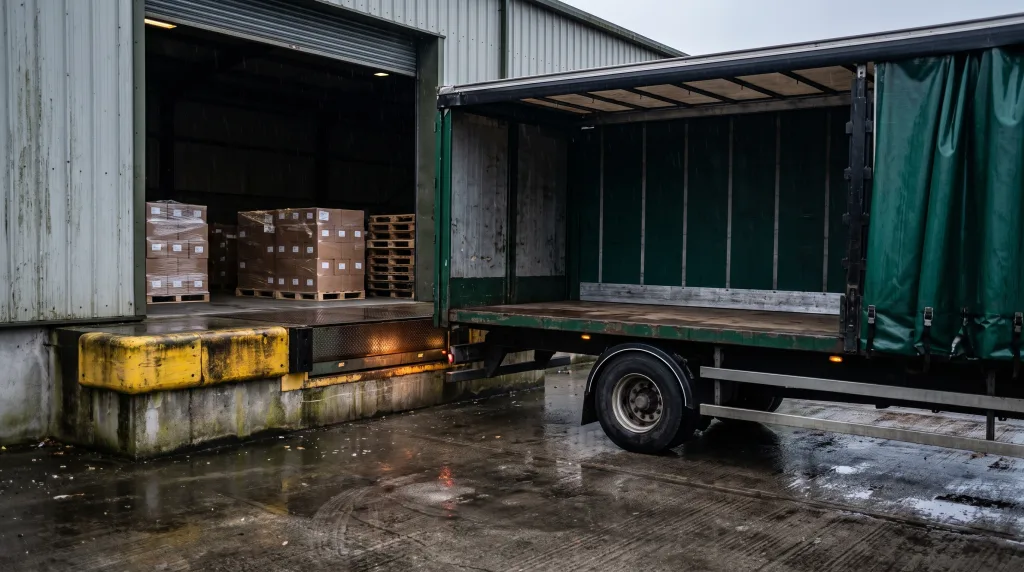
 AI image
Carrier liability insurance will not pay when the loss falls under a policy exclusion: an overnight stop on an unguarded truck park, freight subcontracted to a firm with no policy of its own, or theft with no signs of break-in. It will not cover the full value of expensive goods either, because carrier liability is capped at 8.33 SDR per kilogram. Read the policy before you hand over the load, and insure valuable cargo separately.
Carrier liability insurance protects the carrier, not your goods
Cargo owners often assume that if the carrier „has insurance", the goods are insured. That misunderstanding surfaces only when something goes wrong. A liability policy responds strictly within the limits of the carrier's liability, and in international road transport those limits are set by the CMR Convention. Article 23(3) of CMR caps compensation at 8.33 SDR per kilogram of gross weight short. For light, high-value goods such as electronics, that ceiling can cover a fraction of the real value. We show the mechanics in our article on the 8.33 SDR/kg liability limit.
There is a second layer. Even where the carrier is fully liable, the insurer can refuse to pay, because the policy is a separate contract with its own conditions and exclusions. Your claim survives, but your debtor becomes the carrier personally, with all the insolvency risk that entails. Recovering money from a company whose assets amount to a few leased tractor units is a very different exercise from settling a claim with an insurer.
Typical exclusions in carrier liability policies
Every policy is different, but a handful of exclusions come up so often that we check them first:
- Parking outside guarded truck parks. A parking clause frequently restricts theft cover to stops at guarded or listed locations. A night spent in a lay-by can mean no payout at all.
- Subcontractors. If the carrier passes the freight down the chain and its policy does not extend to subcontractors, a loss at the subcontractor's end sits outside the cover. The subcontractor may carry no liability insurance of its own, or a policy with a low sum insured.
- No gross negligence clause. Standard terms often exclude losses caused by gross negligence. Without the extension, the policy fails precisely where losses are biggest.
- High-risk goods. Electronics, alcohol and tobacco are often excluded outright or subject to a low sub-limit that the shipper discovers only after the loss.
- Driver conduct. Theft with no signs of forced entry, keys or documents left in the cab, driving under the influence: the classic grounds for refusal.
Deductibles: part of the loss always stays outside the policy
A deductible is the amount or percentage the insurer knocks off every settlement. The mechanism is simple: the higher the deductible, the lower the carrier's premium, so a cheap carrier usually runs a high deductible. For the cargo owner it means that even a smoothly handled claim leaves part of the money to be recovered directly from the carrier. The deductible is stated in the policy certificate, and it is worth asking about before the truck reaches the ramp.
Article 29 CMR: gross negligence cuts both ways
Article 29 of the CMR Convention says the carrier cannot rely on the liability limits if the damage was caused by its wilful misconduct, or by default which the law of the court treats as equivalent to wilful misconduct. In many jurisdictions that means gross negligence. On paper this favours the cargo owner: the 8.33 SDR/kg cap falls away and you can claim full value.
In practice the effect is double-edged. The same finding that removes the carrier's liability limit hands the insurer an argument to refuse payment, if the policy excludes gross negligence. You win the argument on principle, and across the table sits a carrier with no insurance behind it. Full compensation on paper and an insolvent debtor in reality: we have seen that scenario too many times.
What you will actually recover: three scenarios
| Situation | Will the liability policy pay | Cargo owner's risk |
|---|---|---|
| Damage in an ordinary road accident | Usually yes, up to 8.33 SDR/kg and the policy limit, minus the deductible | The gap between goods value and the CMR limit |
| Theft from an unguarded truck park | Often refused under the parking clause | Enforcing the whole loss against the carrier's assets |
| Loss caused by gross negligence (Art. 29 CMR) | Often refused without the extension clause | A full claim, but against the carrier alone |
How to protect yourself
- Insure valuable loads with cargo insurance. Cargo cover insures the goods themselves, regardless of whether the carrier is liable and whether its insurer pays. We explain the differences in cargo insurance versus carrier liability.
- Read the policy certificate, not just the sum insured. Check the parking clause, subcontractor cover, gross negligence extension, sub-limits for your type of goods and proof that the premium has been paid.
- Compare the sum insured with the shipment value. For light, expensive goods the CMR limit will be too low anyway, as we show in carrier liability versus real cargo value.
- Put your requirements in the transport order. No subcontracting without consent, guarded parking only, mandatory policy clauses: these provisions discipline the carrier and strengthen your position in a dispute.
The OTSL role
Before we entrust a load to a carrier, we verify its documents, its insurance and its track record, and we write the parking and subcontracting requirements into the transport order. For high-value loads we openly recommend additional cargo cover and help arrange it. Contact us if you want to know what really protects your goods on the road, or browse our knowledge base.
Why does standard carrier liability fail to cover full cargo value?
Standard carrier liability pays strictly according to statutory liability limits based on cargo weight rather than market value. Furthermore, standard policies exclude payouts under specific circumstances such as stops in unguarded parking areas or unauthorized subcontracting, leaving financial gaps unless separate cargo insurance is held.
Step by step
- Evaluate shipment value. Calculate whether standard weight-based liability limits leave a coverage gap for your goods.
- Examine policy terms. Check specific carrier policy exclusions regarding unattended parking and unauthorized subcontracting.
- Identify uninsured operational risks. Ensure the route plan avoids conditions that trigger policy exclusions for theft or damage.
- Secure separate cargo coverage. Protect high-value freight with standalone property insurance covering full goods replacement value.
- Include security terms in instructions. Mandate approved parking sites and transit security requirements in the carriage contract.
Definitions
- OCP (Carrier Liability Insurance): Voluntary insurance covering the road carrier against financial consequences of legal liability for goods in transit.
- SDR (Special Drawing Rights): An international reserve asset used to establish the maximum legal liability limit per kilogram of cargo weight.
- CMR (Convention on the Contract for the International Carriage of Goods by Road): International treaty governing rights, obligations, and financial compensation limits in road haulage.
- Cargo Insurance: Freight insurance purchased by the cargo owner covering the full invoice value of goods regardless of carrier fault.
When does this rule not apply?
The standard statutory compensation cap based on shipment weight does not apply when cargo damage results from gross negligence or intentional misconduct by the haulier.
Sources
UNECE, road transport and the CMR Convention (unece.org)
International Monetary Fund, SDR (imf.org)
EUR-Lex, European Union law (eur-lex.europa.eu)