 AI image
Road tolls are a real and variable part of the freight rate. Across most of Central Europe tolls are charged per kilometre and depend on vehicle weight, the number of axles and the emission class, and since December 2023 in Germany also on CO2 emissions. That is why two similar routes can cost differently.
Why tolls sit inside the rate and how much they weigh
When you get a transport quote, road tolls sit inside the rate and you rarely see them on a separate line. They are a hard cost, though: the carrier pays the state for every kilometre on tolled roads. On longer routes through several countries, tolls can be one of the larger items next to fuel and driver time. Understanding what they are made of explains why the price for a seemingly identical stretch can differ.
Germany: LKW-Maut and Toll Collect
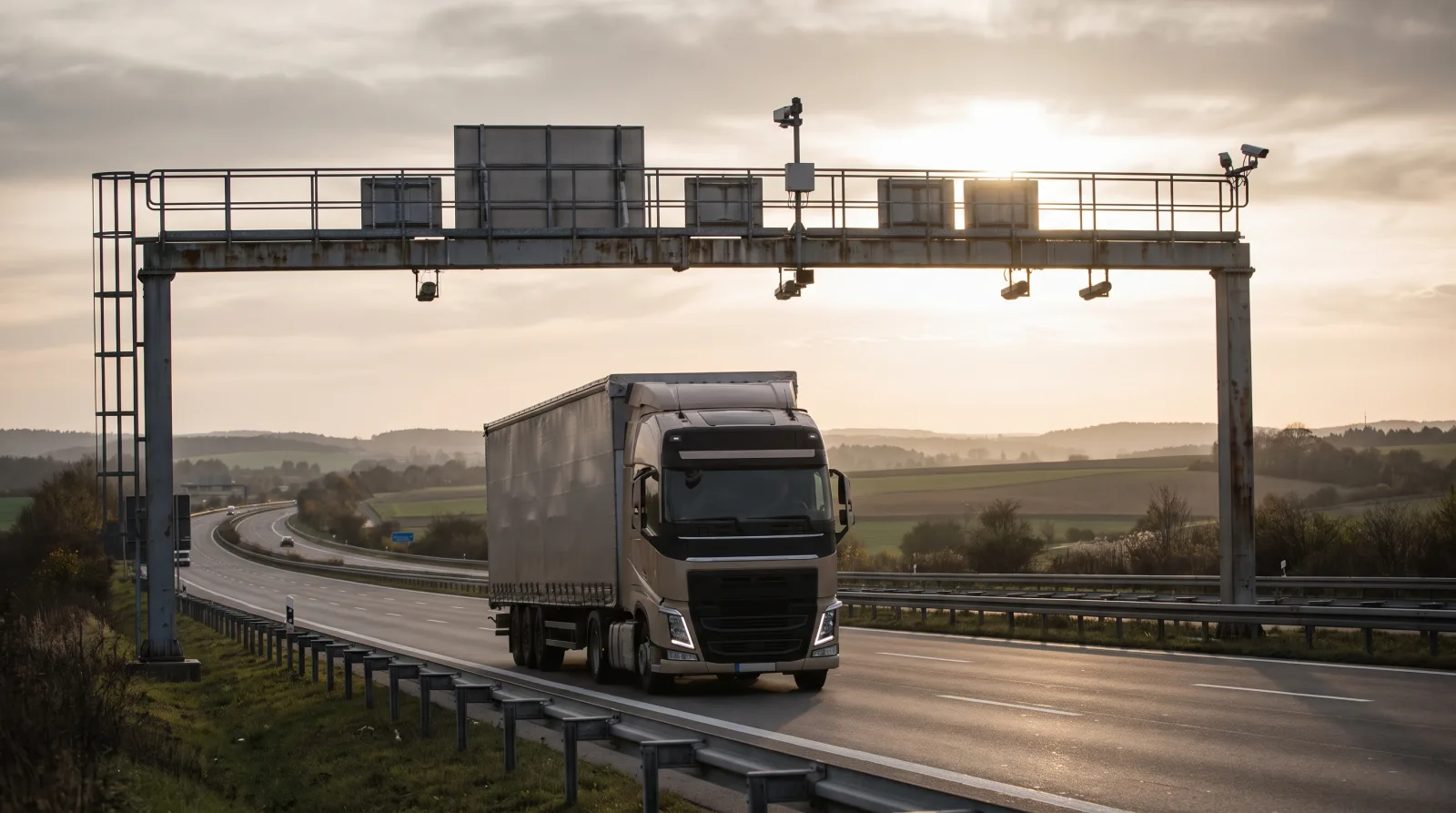
The German LKW-Maut system, run by Toll Collect, is a clear example of per kilometre charging. The rate depends on distance travelled, weight, the number of axles above a certain limit and the emission class. Since December 2023 a CO2 component was added and vehicles were split into five CO2 classes: the cleaner the truck, the lower the surcharge. That is why the same kilometre costs differently for an old and a new truck.
New toll components in Germany: since 1 December 2023 the rate includes a CO2 surcharge set at 200 euro per tonne of CO2, and since 1 July 2024 the toll covers vehicles from 3.5 tonnes gross weight, down from the previous 7.5 tonne threshold (source: Toll Collect).
Austria, Czechia, Slovakia, Hungary and Poland: charging per kilometre
In this part of Europe electronic distance based tolls dominate. The Austrian GO system run by ASFINAG covers motorways and expressways for vehicles over 3.5 tonnes, settled with a GO-Box device (source: ASFINAG). Czechia has MYTO CZ, Slovakia its own electronic system, Hungary runs HU-GO since 2013, and Poland uses e-TOLL (source: e-TOLL). In each the price depends on vehicle category, axles and emission class, so the same kilometre does not cost the same everywhere.
France and Italy: motorways with barriers
In the west and south the model is often different. France and Italy largely use a closed system: the driver takes a ticket on entry and pays on exit, with the charge based on the section driven and the vehicle category. For planning this means that choosing tolled motorways or a longer free road really changes both cost and time. This is one of the decisions we make when arranging road transport.
Why two similar routes cost differently
One kilometre is not like another. The price depends on how many tolled sections and countries the route crosses, the emission class and weight of the vehicle, the number of axles, and whether it runs on barrier motorways or electronic tolling. A route that is shorter in kilometres but crosses a more expensive country or tolled motorways can cost more than a longer detour on cheaper roads.
What else drives the cost of the trip
Beyond the toll itself, other factors load the route: driving bans on weekends and holidays, seasonal limits in the Alps, currency rates because tolls are paid in euro, koruna or forint, and the need for detours. Germany is a useful reference point, so we gathered the details on our transport to Germany page.
How to read tolls in a quote and how to ask about a route
If you want to understand why a given route has the price it does, ask for a split into fuel, driver time and road charges. We are happy to show how the cost builds on your lane. Write through our contact form and we will match the route to your deadline and budget.
Why do similar transport routes carry different road toll amounts?
Toll amounts vary depending on national tariff structures, total vehicle weight, axle count, and emission standards including CO2 categories. Because of these variables, two routes of identical length in different countries or driven by different vehicles can result in distinct toll totals.
Step by step
- Define the route itinerary. You outline the full journey across regions with distance-based tolls.
- Verify vehicle specifications. You check the total vehicle weight, axle setup, and emission class.
- Calculate toll charges. You estimate the total road fees across each national toll system.
- Configure payment units. You verify that onboard units are active for automatic toll collection.
- Include tolls in the quote. You factor the precise road charges directly into the final freight rate.
Definitions
- LKW-Maut (Lastkraftwagen Maut): A distance-based road toll charged to heavy goods vehicles on designated road networks.
- Toll Collect: The German toll collection system operator responsible for processing distance-based charges.
- CO2 class (Carbon Dioxide): An emission rating category that directly influences the road toll rate.
- FTL (Full Truck Load): A transport mode where a vehicle is dedicated exclusively to one single shipment.
The OTSL role
OTSL calculates precise road fees across international transit routes when arranging road transport. We ensure fully transparent freight rates, applying operational practices similar to those required for Swiss deliveries and customs fees.