 AI image
A forwarder locates the truck from three sources: the carrier's GPS telematics, status events reported by the driver and booking slots at loading and delivery points. Road transport FTL and LTL has no single tracking number like a courier parcel. The real product is a reliable ETA and a prompt alert on events, not a second-by-second dot on a map. Silence between statuses usually means the run is going to plan.
How is a forwarder actually knows where the truck?
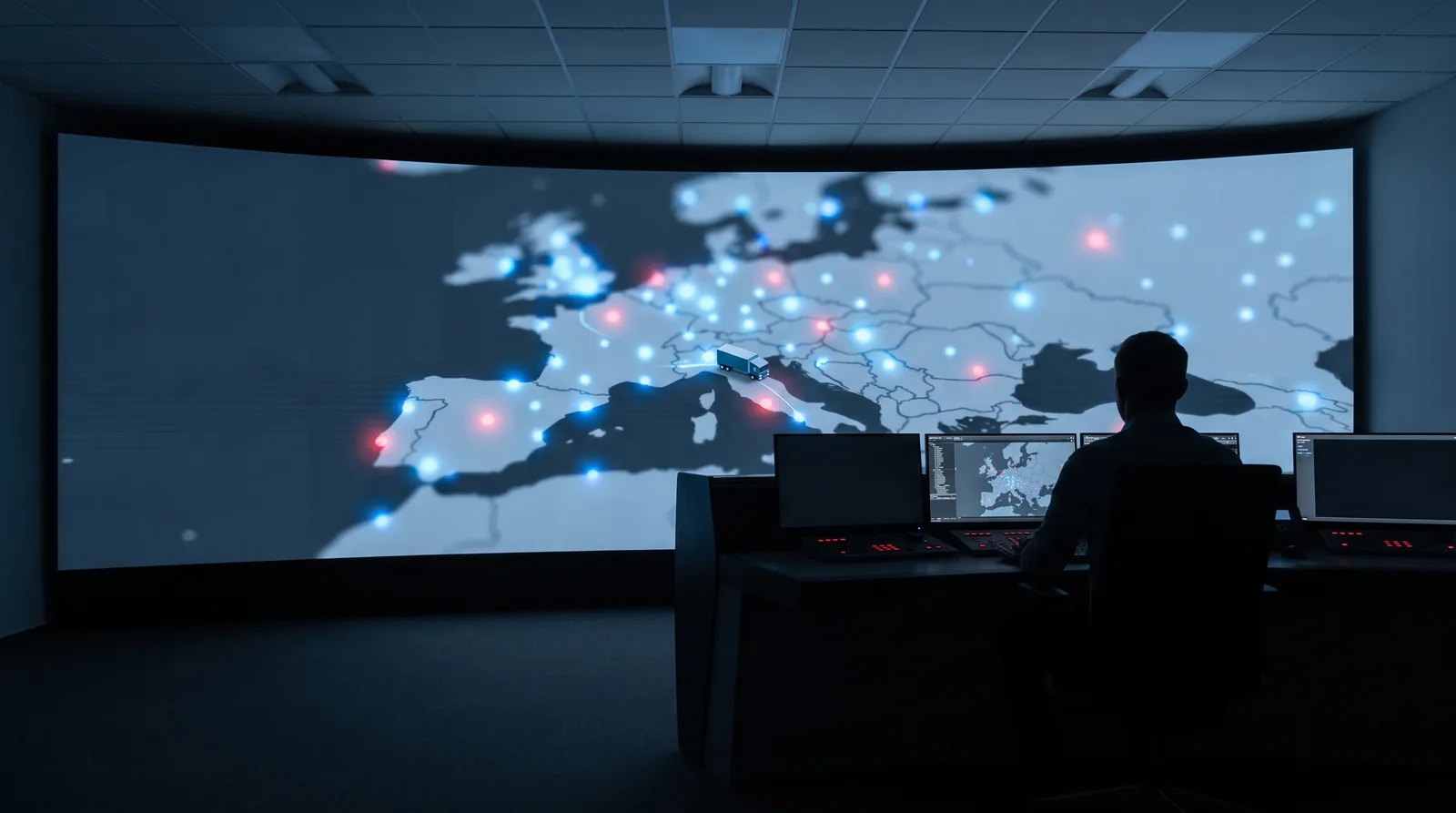
Visibility in road transport does not come from a magic dot on a map. It is built from several layers that the forwarder combines into one picture of the shipment.
- Vehicle GPS telematics. The carrier's tractor unit sends its position to a fleet system. This is the most accurate layer, but it belongs to the carrier, not to the principal. Access to the raw location is often limited, because a driver's position is also personal data and the carrier's commercial secret.
- Status events from the driver. Arrival for loading, loading complete, departure, border, unloading started, delivered. These are events, not a continuous stream. On the road the driver drives and observes driver hours, so reporting happens at a stop, not every minute.
- Booking at the points. Loader and consignee confirm the time windows. In the United Kingdom there is booking-in for UK deliveries, without which the truck does not reach the bay. A slot is a hard point in the schedule and a strong status signal.
- The forwarder's operational control. A person who knows whose cargo it is, the route and the risk of this particular order. This layer turns raw data into an answer to the customer's question.
How these layers fit the whole chain, from taking the order to delivery, is covered in how freight forwarding works.
Why road transport has no single tracking number like a courier
A customer used to a courier parcel expects one number and a map that refreshes the courier's position outside the door on its own. That is realistic in a courier network, because every parcel passes through sorting hubs with scanners: the barcode is scanned at each stage and the system generates the status automatically. The network is built around that scan.
Road transport FTL and LTL works differently. A full truckload runs directly from sender to consignee, often with no terminal in between, so there are no scan points to generate a status on their own. LTL groupage passes through cross-dock terminals, but even then not every pallet is scanned like a parcel in a courier network. Status is created by people and by telematics, not by an automatic scan at every metre of the route.
| Feature | Courier parcel | Road transport FTL and LTL |
|---|---|---|
| Tracking number | one per shipment | usually none; identified by order number or reference |
| Source of status | automatic scan in hubs and depots | GPS telematics, driver status, booking |
| Update frequency | at every scan | at events: loading, border, unloading |
| Customer view | self-service map and scan history | ETA and event alert, set by the account handler |
| Route | through a hub network | FTL direct; LTL via cross-dock terminals |
Realistic expectations: an ETA, not second-by-second location
The visibility product in road transport is a reliable ETA, the estimated time of delivery, plus a fast alert when something happens that changes it. This is not the same as a live dot moving across a map in real time.
Second-by-second truck location may be technically possible on the carrier's side, but it rarely reaches the principal directly and is usually not needed. The driver's position is personal data, and a continuous view of the route exposes the carrier's work organisation. For planning the unloading, the crew at the bay or the next transport, what counts is a predictable ETA and early warning of a slip, not whether the truck is parked at a service station right now.
When silence does not mean a problem
The most common customer worry is: no new status since this morning, something must be wrong. Usually not. In road transport, the absence of a new event is most often proof that the run is going to plan, not an alarm.
- The driver is on the road. Between loading and unloading there may be no natural reporting point for many hours. Driving a truck rules out handling a phone.
- A rest period is in force. The required break under driver hours is a planned, lawful stop, not a breakdown. The truck stands still because the law requires it, and delivery is still realistic within the window.
- Time-zone and working-hour gaps. Silence on the consignee side in the UK or Switzerland is sometimes simply the time of day. When continuous availability matters is covered in 24/7 availability in forwarding.
When silence really does need a reaction: a missed booking window with no entry to the bay, no confirmation of unloading started long after the ETA, a passed booking-in slot in the UK. These are the cases where a good forwarder calls the carrier and the consignee before the customer even asks.
How does OTSL communicate status?
We do not promise a second-by-second map, because in road transport that is an illusion. We promise something more useful: an account handler who knows your order, and a status based on real data from the carrier's telematics, driver reports and booking. We confirm the key events: arrival for loading, departure, border, unloading started, delivered. We update the ETA when the situation on the route changes, and we flag a slip before it becomes the consignee's problem. We do not disclose what must not be disclosed, namely the driver's position as personal data or the details of the carrier's work organisation.
The OTSL role
As an international freight forwarder we merge the visibility layers into one clear status and translate it into the customer's language rather than fleet-system jargon. We run traffic between Poland, the United Kingdom, Switzerland and the rest of Europe, with warehouses in Kielce, Legnica and Milton Keynes, where we control goods-in and goods-out ourselves. More scenarios sit in our transport risks section and the knowledge base, and you can discuss a specific shipment through the contact form.
Step by step
- Data collection. The forwarder gathers telemetry signals from the haulage partner alongside driver status reports.
- Route comparison. The current position of the lorry is checked against the agreed timetable and corridor.
- ETA calculation. Required driver rest periods and remaining distance are factored in to calculate the arrival estimate.
- Exception notification. If any delay occurs, you receive a direct notification explaining the revised schedule.
- Delivery confirmation. Completion of unloading and receipt of transport documents conclude the tracking process.
Definitions
- Track and trace: The process of providing the customer with current status updates and historical data regarding a shipment's movement.
- ETA (Estimated Time of Arrival): The calculated time when a vehicle is expected to arrive at its destination based on live transit progress.
- FTL (Full Truckload): A haulage arrangement where a vehicle carries goods exclusively for a single client.
- LTL (Less than Truckload): A groupage transport method combining smaller shipments from multiple senders into one trailer.
- GPS (Global Positioning System): A satellite network used to pinpoint the exact geographical location of a transport vehicle.