 AI image
The ADR (the Accord governing international carriage of dangerous goods by road) tunnel restriction code decides which tunnels a vehicle carrying dangerous goods must not enter. Chapter 8.6 of ADR sorts road tunnels into five categories, from A (no restrictions) to E (the tightest), and assigns every substance a code in Column 15 of Table A. The code goes into the transport document in capital letters in parentheses (ADR 5.4.1.1.1 (k)). A wrong or missing code can stop a truck at the portal and wreck the whole routing plan.
Where tunnel categories A to E come from
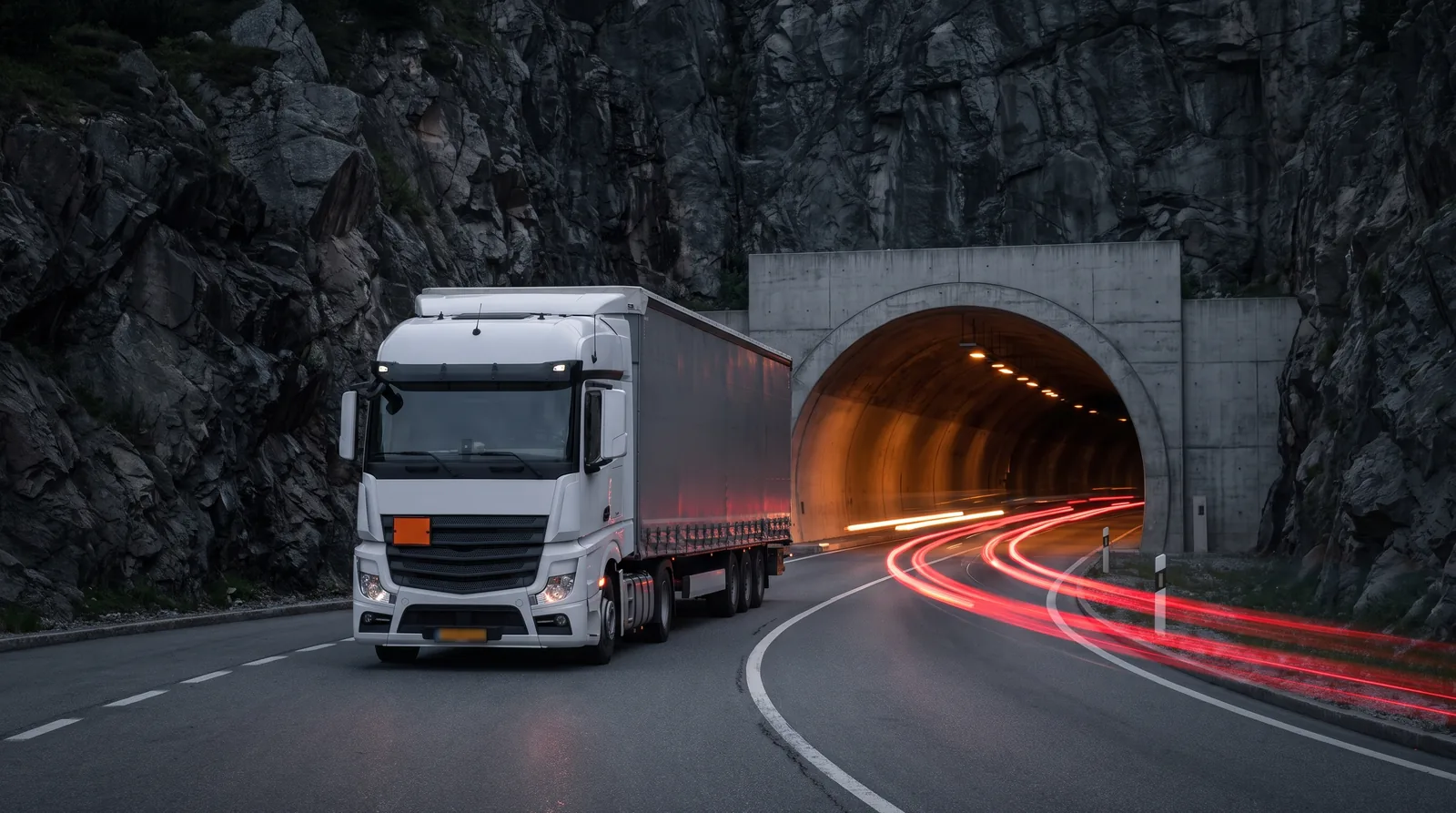
The category is assigned to each tunnel by the competent authority of the country it sits in (ADR 1.9.5). The assessment rests on the three hazards that can cause mass casualties or destroy the structure inside a closed tube: explosion, release of toxic substances and a major fire. For tunnels in the trans-European road network, Directive 2004/54/EC sets the minimum safety requirements, including a risk analysis before dangerous goods are restricted. The entrance of a restricted tunnel carries a prohibition sign with an additional panel showing a letter from B to E; a tunnel without such signage is unrestricted and treated as category A.
Tunnel restrictions apply to transport units that must display orange plates (ADR 8.6.3.1). Carriage under exemptions, for instance below the load thresholds of 1.1.3.6, runs without plates and passes tunnels freely as a rule. Category E is the exception: it also covers limited quantities where the total gross mass exceeds 8 tonnes per transport unit and LQ marking is required. We cover that regime in limited quantities LQ in ADR transport.
Five categories, one logic: the further down the alphabet, the tighter
| Category | Passage forbidden for (ADR 8.6) | Planning consequence |
|---|---|---|
| A | no restrictions for dangerous goods | route unchanged; the category carries no sign |
| B | goods that may lead to a very large explosion | stops loads whose codes start with B |
| C | goods threatening a very large explosion, a large explosion or a large toxic release | stops codes B and C |
| D | goods threatening a large explosion, a large toxic release or a large fire | stops petrol in tanks (code D/E), among others |
| E | all dangerous goods except UN 2919, 3291, 3331, 3359 and 3373 | also covers LQ above 8 tonnes gross per unit |
How to read the codes: D/E, C/E, B/D
The slash separates two scenarios. Petrol, UN 1203, carries code D/E: in a tank it may not enter tunnels of categories D and E, while carriage in packages is stopped only by category E. Code C/E bans tank carriage from category C upwards and packaged carriage from E, and a single letter such as E works the same for every mode of carriage. The further down the alphabet the letters sit, the milder the restriction, because the ban starts only at the tightest tunnel categories.
Groupage follows the weakest-link rule: where one transport unit carries goods with different codes, the whole load takes the most restrictive of them (ADR 8.6.3.3). A single pallet with a severe code can close a tunnel to the entire trailer and stretch the route of every other consignment on board. That is why the codes of all positions are checked before the route is built, not after loading.
The tunnel code in the transport document
ADR 5.4.1.1.1 (k) requires the tunnel restriction code in the transport document, in capital letters and in parentheses, for example (D/E). The entry may be omitted only where it is known in advance that the journey will not pass a tunnel with restrictions. In international practice it is safer to enter the code every time: a cancelled crossing or a closed road changes the routing within hours, and a document without the code ties the dispatcher's hands. The shipper is responsible for correct particulars, so the code should be taken from Column 15 of Table A for the specific UN number, not from memory. Roadside checks compare the document with the load, and a mismatch ends with the vehicle immobilised until the irregularity is fixed. The full list of required entries sits in documents in ADR transport.
Eurotunnel or ferry: ADR across the Channel
ADR tunnel codes govern road tunnels. The Channel Tunnel is a railway: the truck rides on a shuttle wagon, so the categories of Chapter 8.6 do not apply to it directly. What travels is decided by the operator's conditions of carriage, which include the operator's own list of dangerous goods accepted, accepted conditionally and excluded from the crossing. Some ADR loads will not board the train and must sail. A ferry, in turn, is a maritime regime: the sea leg falls under the IMDG Code, and dangerous goods must be declared to the operator at booking. The operator confirms acceptance and may assign a specific sailing; ADR that was never declared means refusal at check-in and a lost slot in the port.
The planning conclusion: for dangerous cargo bound for the United Kingdom, the choice of crossing is a question of load acceptance, not of price and departure time, so the operator's policy is checked before the order is confirmed, not at the port. How we weigh the two routes is described in ferry or Eurotunnel, and the customs and paperwork side of the corridor in ADR transport to the UK after Brexit.
Route planning with a tunnel code
- Collect the codes before quoting. The tunnel code of every position must be known before the route is built; in groupage the most restrictive code decides everything.
- Check the tunnel categories on the route. National authorities publish lists of categorised tunnels, and entrances are signed with a letter panel. Restrictions concentrate on long transit tunnels, above all in the Alps.
- Price the detour before the truck rolls. A ban means a mountain pass or a longer corridor: extra kilometres, driving time and cost that belong in the quote.
- Declare ADR on the crossing. A dangerous goods declaration at ferry booking or a check of the Channel Tunnel operator's list is the condition for keeping the delivery date.
- Verify the transport document. The code in parentheses must match Column 15 of Table A, and for limited quantities watch the 8-tonne threshold of category E.
The OTSL role
As an international freight forwarder we plan ADR movements between Poland, the United Kingdom, Switzerland and the rest of Europe, on corridors where tunnel codes and crossing operators' policies meet in a single order. We check the codes before quoting, match the crossing to the load and keep the document entries complete, while warehouses in Kielce, Legnica and Milton Keynes let us buffer goods on both sides of the Channel. The basics of dangerous goods carriage are collected in ADR transport of dangerous goods, and a load with a tunnel code can be discussed through the contact form.
What does a two-part tunnel code with a slash mean?
A two-part code separated by a slash, such as D/E, indicates different restrictions depending on how the goods are transported: the first letter applies when goods travel in tanks, while the second letter applies to all other methods of carriage.
Step by step
- Identify the substance. Find the UN number and proper shipping name in your goods documentation.
- Check the restriction code. Locate the assigned code in the main ADR dangerous goods list.
- Consider the transport mode. Determine whether carriage is in tanks or packages to correctly read two-part codes.
- Review the tunnel route. Map out the journey to ensure no restricted tunnel categories are present along the path.
- Complete the transport document. Write the code in capital letters inside parentheses within the shipping paperwork.
Definitions
- ADR (Agreement concerning the International Carriage of Dangerous Goods by Road): The international treaty governing the safe road transport of dangerous substances across borders.
- Tunnel restriction code: A specific code assigned to dangerous goods that determines which road tunnels the vehicle cannot enter.
- Tunnel category: The classification system ranking road tunnels from A to E based on their safety and access restrictions.
- Table A: The central list in ADR regulations detailing specific transport restrictions and coding for every dangerous substance.