 AI image
The typical cargo theft in Europe is not a highway robbery. It is a curtain slashed at night on an unguarded truck park while the driver sleeps in the cab. Secure parking is scarce, and a driver's legal driving time ends where it ends. Before you sign the order, ask the carrier about planned stops, the parking clause in its insurance and how it selects overnight locations.
What a truck park theft actually looks like
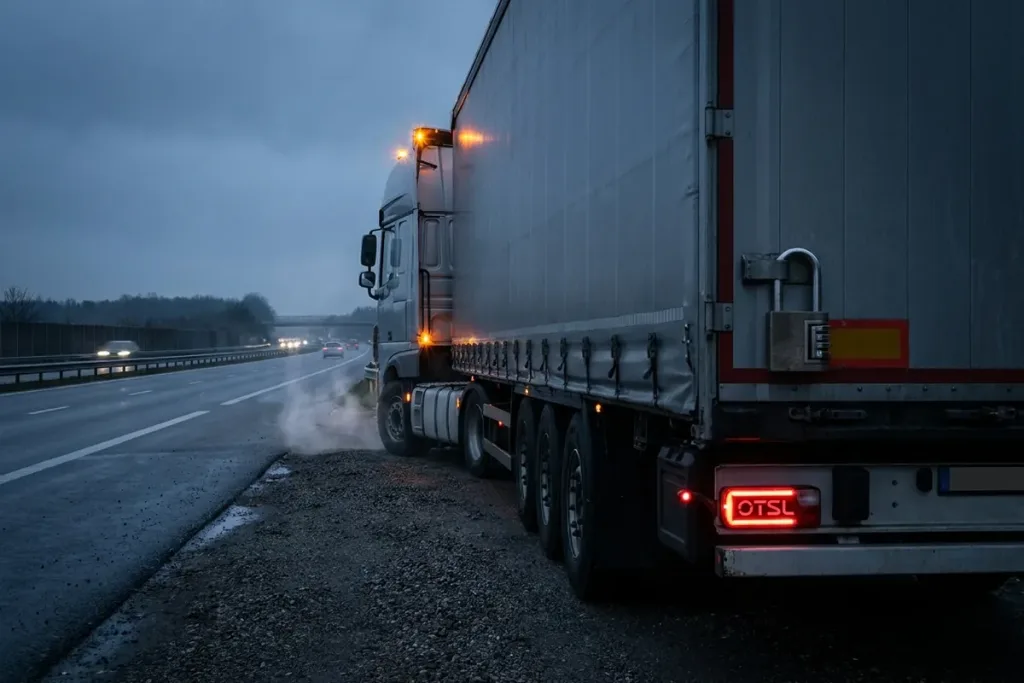
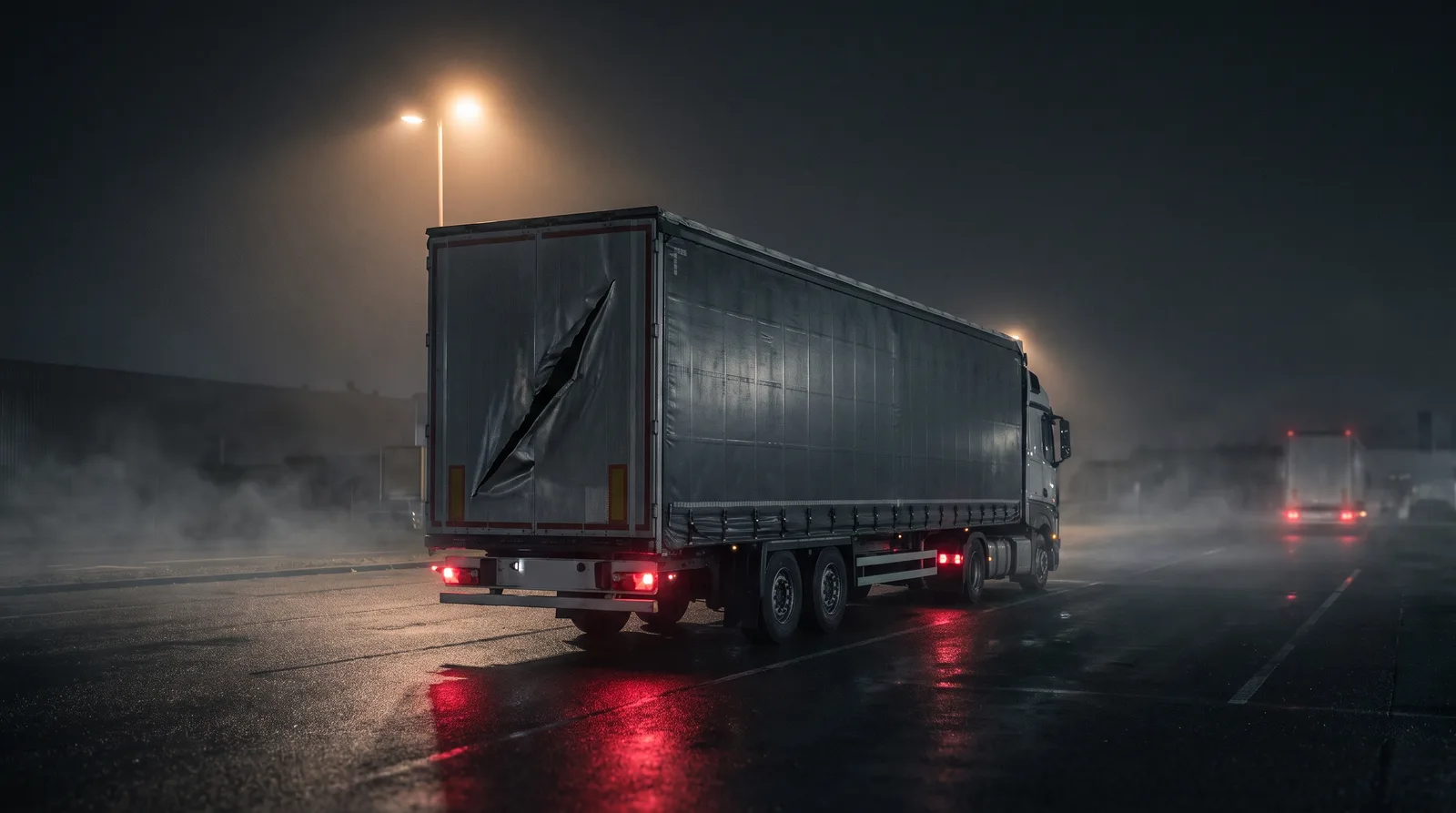
The script has not changed for years. A curtain-sider pulls in for the night at a motorway service area or a lay-by. After midnight someone slits the curtain along the side, checks what is inside and carries the goods to a van waiting nearby. The driver sleeps a metre away and usually hears nothing, because cutting a curtain is quiet. The morning brings a ripped tarpaulin, missing cartons and a police report in a foreign language.
Thieves choose their targets calmly. They watch truck parks on busy transit corridors, they know the hours when drivers are forced to stop, and they can tell from seals and paperwork which trailer carries electronics and which carries waste paper. The risk is not random. It concentrates where the load is attractive, the route predictable and the overnight stop improvised.
Why the truck with your goods sleeps just anywhere
Drivers do not park in lay-bys for comfort. They do it because driving time rules are unforgiving: when the daily limit runs out, the truck must stop within the next few dozen minutes. Across Europe there are far fewer guarded and certified parking spaces than trucks looking for one every night, and on the busiest corridors the free spaces are gone by early evening. The EU institutions have described this deficit for years and co-fund new safe and secure parking areas, but the gap remains wide.
Then there is the economics. A guarded truck park costs money; a lay-by is free. A carrier that won the freight with the lowest rate has no margin to spend on secure stops and does not plan the route around their availability. The cheapest quote on the exchange often means exactly that: a night wherever the tachograph said stop, with no guard, no cameras and no plan B.
What do you lose when the curtain gets cut?
The loss rarely ends with the stolen items. Add the whole delivery being held for investigation, inspection of the remaining goods, sometimes rejection of the batch by the consignee, late-delivery penalties from retail customers, and the cost of return or storage. On top of that, the carrier's liability is capped by the CMR Convention, as we explain in our article on the 8.33 SDR/kg limit. And if the carrier's policy contains a parking clause restricting theft cover to guarded sites, the insurer may refuse to pay at all. We take that mechanism apart in when carrier insurance does not pay.
TAPA PSR: telling a secure site from a lit one
„Secure parking" has no single definition and gets stretched to cover anything with a barrier. That is why the industry uses TAPA PSR, which describes requirements in graded levels: fencing, lighting, entry registration, CCTV, patrols, 24-hour guarding. In parallel, the EU is developing a network of certified safe and secure truck parking areas along the main corridors. For a shipper the practical conclusion is simple: the order can name a specific parking standard, instead of hoping the carrier interprets „safe parking" the way you would.
What to check in the transport order before you commit the load
- Route and stop plan. Ask for the planned route with overnight locations. For theft-attractive goods, stops should fall at guarded or certified sites, not wherever the day happens to end.
- The parking clause in the policy. Request the insurance certificate and check whether theft cover is limited to specific types of parking. A policy that excludes unguarded sites, combined with a route that has no stop plan, is a ready-made refusal.
- No subcontracting without consent. Every extra link in the chain means losing control over who is actually driving with your goods. The extreme version of that risk is described in our piece on the fake carrier from the freight exchange.
- Communication and tracking. Telematics with vehicle position and an agreed way of reporting stops let you spot deviations from the plan before they become losses.
- Cargo insurance for valuable goods. For electronics, cosmetics or alcohol, a cargo policy tends to cost less than one night of uncertainty. The differences are explained in cargo insurance versus carrier liability.
Why the cheapest rate can be the most expensive
A freight rate reflects the costs the carrier intends to incur. Secure stops, decent equipment, experienced drivers and a solid policy all cost money. If a quote sits clearly below the market, the difference has to come from somewhere, and it usually comes from the items you cannot see in the quotation email: overnight stops anywhere, a policy full of exclusions and the freight quietly passed to an unknown subcontractor. You pay less for the freight, but you are the one financing a risk nobody priced.
The OTSL role
We match carriers to the value of the load, checking their policies and their actual parking practice, we write the parking requirements into the order and we monitor execution. For high-risk goods we plan the route around the availability of secure stops and recommend additional cargo cover. Contact us if your goods are the kind thieves shop for, or browse our knowledge base.
Scale of the problem: according to TAPA EMEA data from 2025, over 108,000 supply chain thefts were recorded in the EMEA region within two years, and losses from just the 5% of reports that stated a value exceeded EUR 1 billion, around EUR 1.3 million every 24 hours (source: TAPA EMEA).
Step by step
- Verify the insurance policy. Review the carrier's parking clause in detail before accepting the transport offer.
- Agree on designated stops. Establish specific compliant parking locations along the route before the journey starts.
- Draft clear order conditions. Insert exact security standards for parking sites into the transport contract.
- Monitor vehicle transit. Track the position of the truck during transport to confirm adherence to the planned stops.
- Report security breaches. Notify authorities and insurers immediately if any curtain damage or unauthorized access is detected.
Definitions
- TAPA PSR (Transported Asset Protection Association Parking Security Requirements): an international standard grading truck parking facilities based on physical and technical security criteria.
- Curtain-sider: a commercial vehicle body type with flexible fabric side curtains that can be easily cut.
- Parking clause: a specific insurance policy condition setting overnight parking location requirements for theft coverage to remain valid.
- Carrier's Liability Insurance (OCP): insurance coverage protecting the haulier against financial liability for cargo loss or damage during transit.
When does this rule not apply?
The requirement to use certified parking sites does not apply in emergency situations involving direct orders from traffic authorities or police, unless the insurance policy strictly excludes coverage for losses occurring outside designated safe zones under any circumstances.
Sources
European Commission, DG Mobility and Transport (transport.ec.europa.eu)
UNECE, road transport and the CMR Convention (unece.org)