 AI image
An FTL (full truckload) rate is the sum of its components: fuel, road tolls, driver time and vehicle cost, plus on the UK route a ferry or tunnel crossing and two customs clearances. Season and the chance of a return load matter too. That is why a serious quote always refers to a specific route, date and cargo, never to a universal price list.
Fuel: the component with a life of its own
Diesel is the biggest single variable cost in road transport and the only one the carrier does not control. Prices move with the fuel market, so longer contracts use fuel adjustment clauses, and spot quotes reflect the price on the day of the enquiry, not last month.
Tolls: every country counts differently
The German toll depends on the permitted total weight, the number of axles and the emission class of the vehicle, and since 2023 also on a CO2 component. Other transit countries run their own systems: tolled sections, vignettes, barriers. The longer the transit through high-toll countries, the bigger the share of road charges in the rate. That is why two orders over a similar distance can carry different prices.
The Channel: ferry or tunnel
The UK route adds a crossing. The price depends on the operator, booking date, time of day and occupancy, and in peaks it can swing considerably. Flexibility on the crossing time usually lowers the cost; a rigid window raises it. How crossing bookings work is described under ferry booking.
The border: two clearances, not one
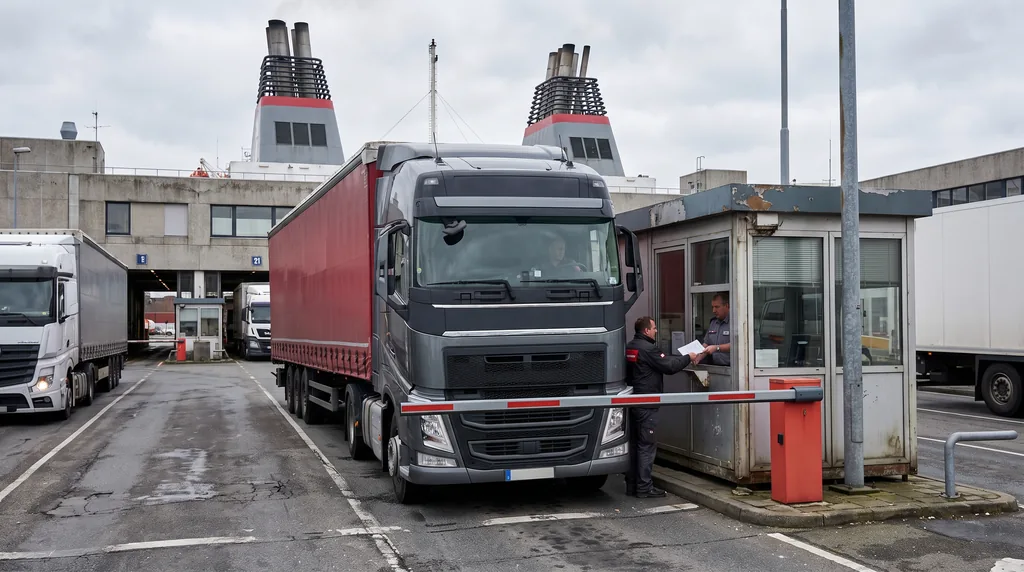
Since Brexit every commercial load goes through export clearance in the EU and import clearance in the UK. That is a customs clearance cost, but also a time risk: missing documents mean a standing truck, and a standing truck costs money whether it moves or not. We run clearances on both sides in our own agencies, details under customs clearance.
The driver and the vehicle clock
Regulation (EC) No 561/2006 caps daily driving time, so a run from Poland to England is several days of work for the vehicle and the driver. Waiting time is in the rate too: for loading, for unloading, for the crossing. A receiver who holds the truck at the ramp pays for it in future quotes, even if the line item is invisible.
Season and directional balance
In demand peaks trucks are scarce and rates climb; in troughs the opposite. The second mechanism is return loads: a destination with little chance of a backload has to earn part of the empty kilometres. So the same distance can cost very differently depending on which way across Europe it runs.
Empty kilometres in numbers: according to Eurostat, 21.6% of all road freight vehicle-kilometres in the EU in 2024 were run empty; those empty kilometres have to be earned by paid freight, which is why a lane with little chance of a backload costs more (source: Eurostat).
How does to get a quote that hold?
State the route with postcodes, the date, the weight, the pallet count and any special requirements. We discuss the UK direction more broadly in how much transport to the UK costs, and if your batch does not fill a truck, groupage is often the cheaper starting point.
Step by step
- Specify route and schedule. Define the loading point, destination, and expected date of transport.
- Provide cargo details. Supply accurate weight and volume specifications required for vehicle selection.
- Account for road tolls. Assess the transit route for applicable tolls and pay-to-drive sections.
- Verify border requirements. Check the necessary customs formalities when moving goods across borders.
- Confirm the quotation. Accept the freight conditions and submit the transport order.
Definitions
- FTL (Full Truckload): A full truckload transport where the entire cargo space of the vehicle is reserved for a single shipper.
- BAF (Fuel Adjustment Factor): A fuel adjustment clause used to align freight rates with fluctuations in diesel market prices.
- Road toll: A charge for using toll roads determined by vehicle weight, number of axles, and emission standards.
- Spot quote: A single freight price calculation based on current market conditions on the day of enquiry.
The OTSL role
OTSL calculates transport rates and manages international routes by combining Road transport (FTL) with border formalities and ferry bookings. For urgent delivery needs alongside standard shipments, read our guide on Express vans and time-critical transport in Europe | OTSL.