 AI image
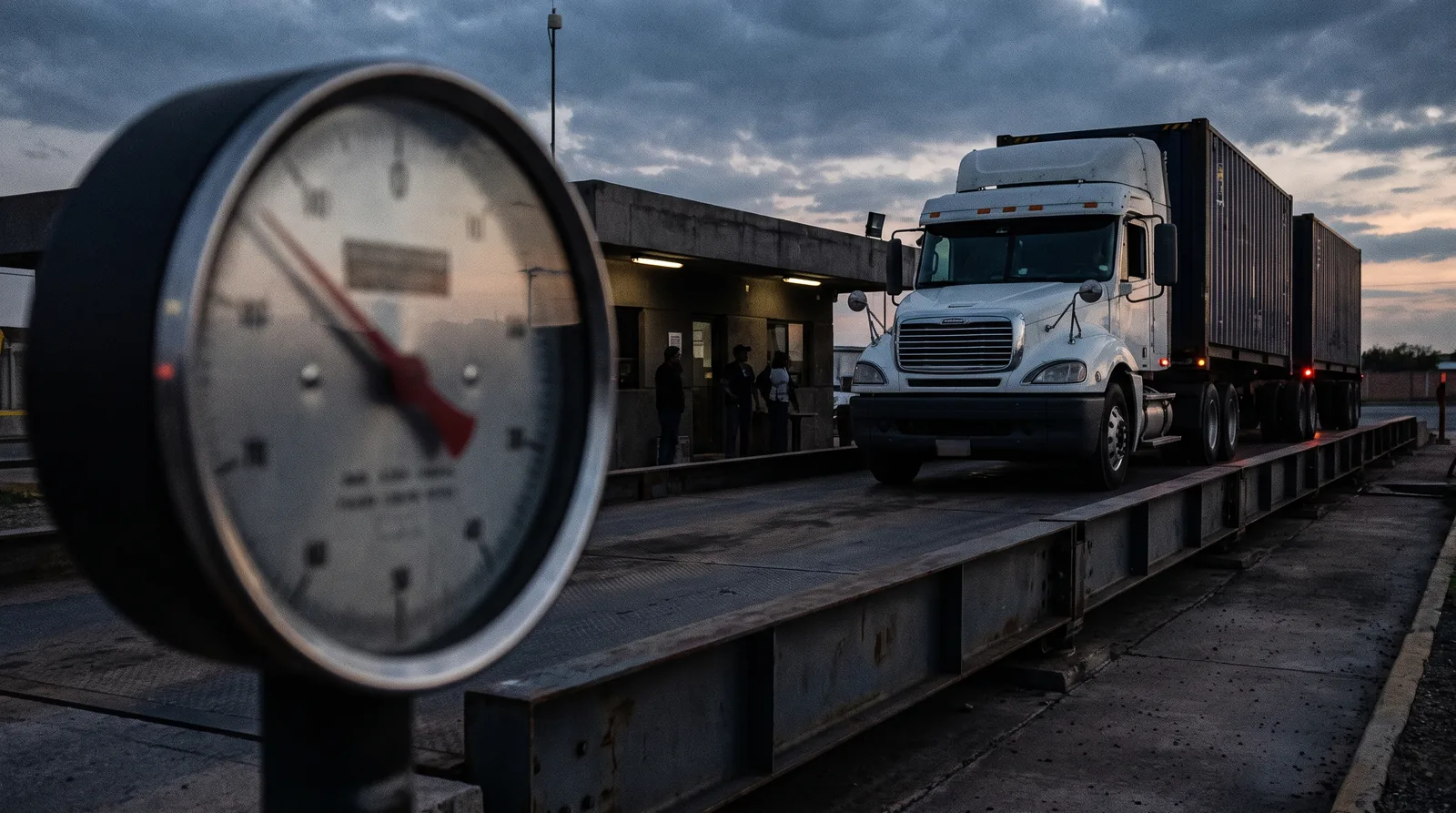
In EU international traffic a standard articulated lorry runs at a gross vehicle weight of 40 tonnes. The tractor and trailer weigh around 14-16 tonnes, leaving roughly 24-26 tonnes for cargo. The exact payload depends on the individual combination, and axle load limits often bite before the total does. That is why forwarders ask about weight first.
Where “24 tonnes” comes from and why it is a shortcut
“A trailer takes 24 tonnes” circulates in purchasing and production departments as if it were a law of nature. It is only a convenient rounding: 40 t GVW minus roughly 16 t of empty weight for a heavier combination. A lighter set, a tractor unit with a classic curtainsider, can legally carry 25 or even 26 t. Heavier bodywork works the other way: a refrigerated trailer with its cooling unit or a specialised trailer weighs more, so the payload drops, sometimes clearly below 24 t. There is no single number for “a trailer in general”, only the payload of a specific combination stated in its vehicle documents.
The stakes are practical, especially if you buy goods in Poland or ship UK-bound freight through a European haulier. Plan a load “for 24 tonnes” without checking the vehicle and two things can happen. Either the truck arrives and legally takes less than what is waiting on the ramp, and the remainder pays for a second transport. Or the goods travel overloaded and stop at the first weighbridge, with a fine, lost time and a transhipment at the expense of the parties involved. Both cost more than one question about the real payload before loading.
What the law actually says about 40 tonnes
Weights and dimensions in EU international traffic are governed by Directive 96/53/EC. For the typical combination, a two-axle tractor with a three-axle semi-trailer, the limit is 40 t. Combined transport is the exception: a combination carrying a 40-foot container as part of an intermodal operation may run at up to 44 t. In Poland the standard five-axle combination also runs at up to 40 t in domestic traffic.
On the corridors we serve most often, several regimes apply at once. In Great Britain a six-axle articulated lorry may run at up to 44 t in domestic traffic, as described in the official GOV.UK guidance, but an international haul from Poland is planned around the limits of every country on the route. Switzerland applies a 40 t limit; check the current federal rules on fedlex.admin.ch. The takeaway for a shipper: the permitted weight follows the route, not habit.
| Limit | Value | Basis |
|---|---|---|
| 5-6 axle combination, EU international traffic | 40 t | Directive 96/53/EC |
| Combined transport with a 40 ft container | up to 44 t | Directive 96/53/EC |
| Driving axle | 11.5 t | Directive 96/53/EC |
| Single non-driving axle | 10 t | Directive 96/53/EC |
| Tri-axle trailer bogie | 21-24 t, depending on axle spacing | Directive 96/53/EC |
| 6-axle articulated lorry, GB domestic traffic | up to 44 t | GOV.UK |
Axle loads: the limit that stops you before the total does
A combination weighing less than 40 t in total can still be illegal. Directive 96/53/EC caps not only the sum but also the load on individual axles: 11.5 t on the driving axle, 10 t on a single non-driving axle, 21-24 t on a tri-axle trailer bogie depending on spacing. A few heavy crates pushed against the front wall of the trailer can overload the driving axle even though the whole load sits within the total limit. The weighbridge then shows an axle overload rather than a gross one, and the result is the same: the vehicle is stopped and a penalty follows.
This is why weight distribution is planned before loading, not corrected afterwards. We show step by step how to spread a load so the vehicle passes the weighbridge in our article on axle weights in practice. And who actually pays the fine when a check shows an overload, including when the loader rather than the carrier is liable, is covered in axle overload: who pays the fine.
Pallets: weight fills the trailer faster than the floor
A standard 13.6 m trailer takes 33 Euro pallets of 800 × 1200 mm in a single layer. An EPAL pallet itself carries up to 1500 kg in transit, so 33 pallets offer a theoretical 49.5 t of carrying capacity, nearly twice what the vehicle is allowed to take. The constraint is therefore neither the pallet nor the floor, but the payload. At 25 t of payload, each of the 33 pallets averages about 750 kg. Pallets weighing a tonne each end the loading at 25 units, with eight pallet spaces travelling empty.
- Light cargo. The trailer fills up by floor space, not by weight, and the price follows loading metres. How forwarders convert occupied space into freight is explained in loading metres (LDM) in freight pricing.
- Heavy cargo. The weight limit closes the trailer before the floor runs out. What counts is the real, weighed mass of every pallet, not a catalogue figure.
- Mixed cargo. Heavy batches are spread along the trailer between lighter ones to keep axle loads legal and use the space.
- Quick check. Run your own load through the calculator in our tools, and check pallet dimensions and capacity in the Euro pallet (EPAL) in practice.
Why does the forwarder ask for the weight?
The weight question is not paperwork for its own sake; it is the condition of a legal and sensibly priced haul. The mass determines the choice of vehicle, the distribution across the axles and the freight price. A declaration of “about 20 tonnes” that turns out to be 24 on the weighbridge means a stopped vehicle, a penalty, a transhipment and missed delivery slots, and on cross-border routes also lost customs appointments. A shipper who states the gross mass including packaging and pallets, rather than the net mass of the goods alone, avoids all of those conversations. The good practice is simple: weigh instead of estimating, and give the figure together with the pallet count and dimensions.
The OTSL role
As an international freight forwarder we calculate the payload before quoting, not after loading: we ask for the weight, dimensions and pallet count, match the vehicle to routes across Poland, the United Kingdom and Switzerland, and plan the weight distribution so the vehicle passes every check. In our warehouses in Kielce, Legnica and Milton Keynes we can weigh, repalletise and consolidate goods before the onward leg. More scenarios sit in our transport risks section and the knowledge base, and you can describe your load through the contact form.
Step by step
- Check cargo weight. Determine the exact gross mass of your goods before requesting a freight quote.
- Confirm unladen weight. Verify the empty weight of the tractor and trailer combination.
- Calculate available payload. Subtract the unladen weight of the vehicle from the total gross vehicle weight limit.
- Plan load distribution. Position cargo evenly across the trailer to avoid exceeding individual axle load limits.
- Verify total mass. Check the loaded combination on a weighbridge prior to departure.
Definitions
- GVW (Gross Vehicle Weight): The maximum permitted mass of a vehicle combination including cargo, fuel, and driver.
- Payload: The difference between the gross vehicle weight and the empty weight of the combination available for cargo.
- Empty weight: The unladen mass of the tractor and trailer ready for road transport.
- Axle load: The portion of total vehicle weight transmitted to the road surface by a single axle or axle group.
Sources
- Directive 96/53/EC: maximum authorised weights and dimensions (eur-lex.europa.eu)
- European Commission: weights and dimensions of road vehicles
- GOV.UK: vehicle weights explained
- EPAL: EPAL 1 pallet data sheet, dimensions and load capacity (epal-pallets.org)
- Fedlex: Swiss federal law, road traffic rules (fedlex.admin.ch)