 AI image
To settle a run OTSL needs three things from you: the carrier's copy of the CMR consignment note signed and dated by the consignee, the POD, meaning a scan or photo of the signed CMR or of the consignee's goods receipt, and an invoice that quotes the OTSL order number and matches the agreed rate. Documents are handed over in the form and time set in the cooperation agreement; payment terms, delivery of CMR originals and any deductions are not published. In case of damage you add photos from loading and unloading, a copy of your OCP policy and a description of the event.
Which copy of the CMR proves that the carriage was performed?
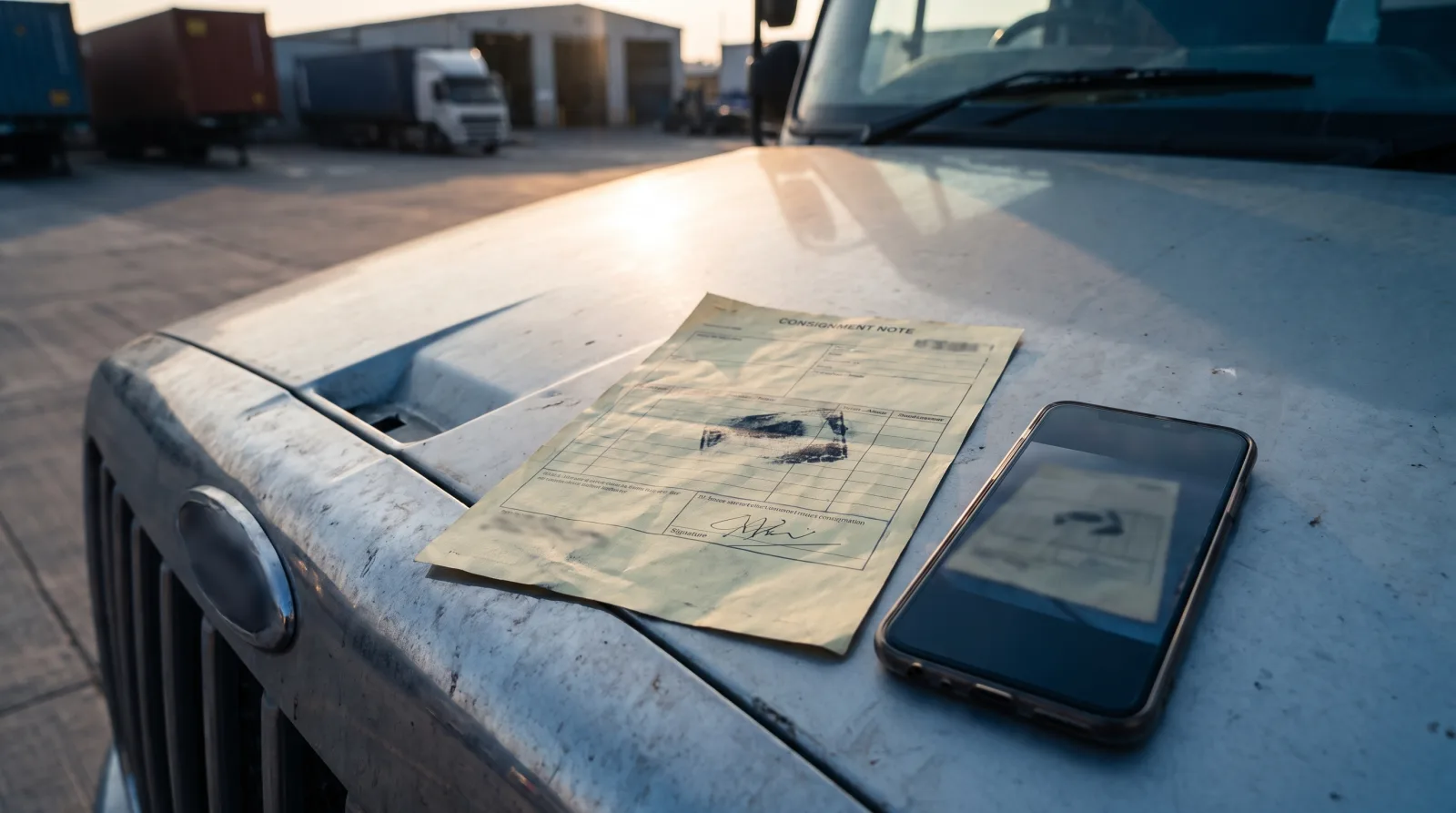
The CMR consignment note is issued in three copies: for the sender, for the consignee, which travels with the goods, and for the carrier. Your copy, signed and dated by the consignee, is the proof that the carriage was performed and it is what closes the run at OTSL. Without the consignee's signature or without a date the document only says the goods were loaded, not that they arrived. That is why the driver does not leave the unloading point until his copy carries a signature, a date and, where the consignee uses one, a stamp.
The consignee's reservations about the condition of the goods are entered on the CMR at delivery. Damage not apparent at delivery may be notified by the consignee in writing within 7 days of delivery under Article 30 of the CMR Convention. A carrier who does not know this loses arguments in a dispute: if a claim arrives after a week and you have no photos from unloading, it is hard to show in what condition the goods left the trailer.
What is a POD and why does OTSL archive the full document set?
The POD, proof of delivery, is a scan or photo of the signed CMR or of the consignee's goods receipt. You send it to the forwarder right after unloading, so that the OTSL customer has confirmation of delivery the same day, and you deliver the original CMR in the form and within the time set in the agreement. OTSL archives the full document set of the order: the order, the CMR, the POD, correspondence and photos. We do this so that in case of damage it is clear who is responsible for what, not to look for deductions against you.
The invoice must quote the OTSL order number and match the agreed rate. An invoice without an order number comes back to you, because it cannot be matched to a run, and an invoice with a rate other than the one agreed comes back with a question. The payment term is set in the cooperation agreement and we do not publish it, nor the way originals are delivered or the rules on deductions, if the agreement provides for them.
Settling a run step by step
- Consignee's signature on the CMR. The driver obtains on his copy the consignee's signature, date and stamp where used; the consignee's reservations are written on the document, not just spoken.
- Photos at unloading. The driver photographs the goods on the trailer and after they come off, especially where there are reservations or visible packaging damage.
- POD to the forwarder. A scan or photo of the signed CMR or goods receipt reaches OTSL the same day so that the customer receives confirmation of delivery.
- Original CMR. You hand over the carrier's copy in the form and within the time set in the cooperation agreement.
- Invoice with the order number. You issue the invoice with the OTSL order number and a rate matching the agreement; the payment term follows from the agreement.
- In case of damage: the set for the insurer. Photos from loading and unloading, a copy of the OCP policy and a description of the event; without them the claim against the insurer does not start.
Definitions
- CMR (Convention relative au contrat de transport international de marchandises par route): the convention on the international carriage of goods by road; the CMR consignment note is issued in three copies, for the sender, the consignee and the carrier.
- POD (proof of delivery): evidence of delivery in the form of a scan or photo of the signed CMR or of the consignee's goods receipt, sent to the forwarder right after unloading.
- Goods receipt (Polish WZ): the consignee's warehouse document confirming acceptance of the goods; it can serve as a POD alongside the CMR.
- Reservation on the CMR: the consignee's entry about the condition of the goods at delivery; damage not apparent at delivery may be notified in writing within 7 days under Article 30 of the CMR Convention.
- OCP (carrier liability insurance): the Polish policy from which compensation for damage to goods is paid; a copy is part of the document set in case of damage.
- OTSL order number: the identifier of the run which the carrier's invoice must quote so that it can be matched to the carriage.
Checklist of documents after the run
- Carrier's copy of the CMR with the consignee's signature, date and stamp where used.
- Consignee's reservations, if any, written on the CMR, not merely stated orally.
- Photos of the goods at loading and unloading saved with date and time.
- POD, a scan or photo of the signed CMR or goods receipt, sent to the forwarder the same day.
- Original CMR handed over in the form and within the time set in the cooperation agreement.
- Invoice quoting the OTSL order number and a rate matching the agreement.
When does a signed CMR not close the matter?
A CMR signed without reservations is proof of delivery, but it does not close the way to a claim: damage not apparent at delivery may be notified by the consignee in writing within 7 days of delivery under Article 30 of the CMR Convention. The rule "clean CMR, case closed" therefore does not apply to hidden damage, unless you have photos from unloading showing the condition of the goods at the moment of handover. Settlement depends on the cooperation agreement: payment term, form of originals and deductions are not published and may differ between partners. In case of damage the CMR alone is not enough; without photos, a copy of the OCP policy and a description of the event the claim against the insurer does not start, whoever is at fault.
The OTSL role
OTSL receives the POD, archives the full document set of the order and settles the run under the cooperation agreement, and in case of damage handles the matter with the customer and the insurer on the basis of the documents it receives from you. How we check carriers before the first run is described on the service page vetted carriers and OCP checks. How to draw up a damage report and secure evidence is explained in damage report and CMR reservations, declared value in declared value in the CMR, and the risk of long payment terms in payment terms in transport. Questions about cooperation go through the contact form.