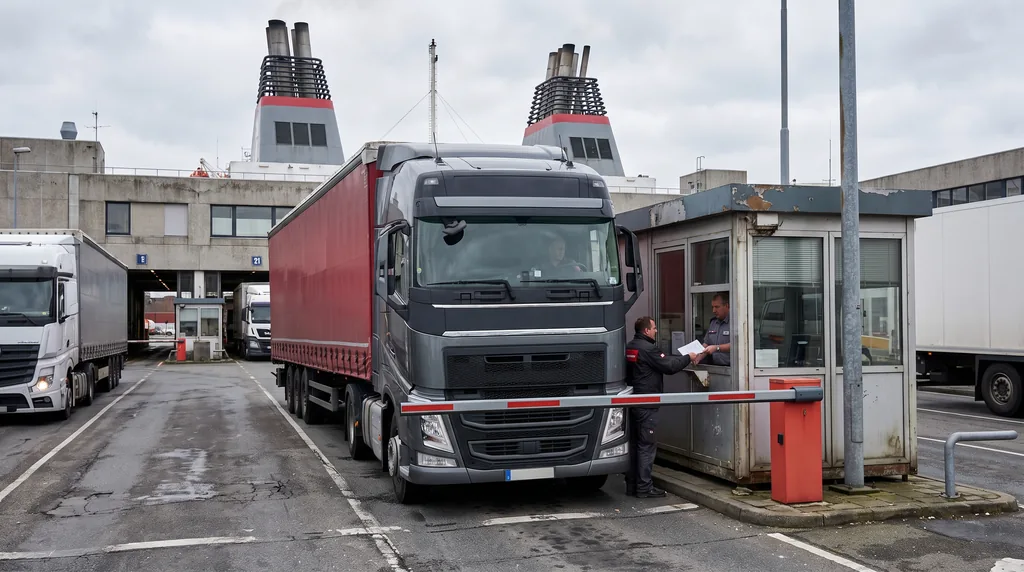
 AI image
In practice the sender fills in boxes 1 to 15 of the CMR note: sender and consignee details, the places of delivery and loading, the description of the goods, the number of packages, the gross weight and the attached documents. The carrier adds its details, vehicle plates and any reservations, and the consignee confirms receipt in box 24. The mandatory content follows from the CMR Convention.
The CMR note: evidence, not paperwork
Under Articles 4 and 9 of the CMR Convention the consignment note is evidence of the contract of carriage, its terms and the taking over of the goods by the carrier. Importantly, the absence or irregularity of the note does not invalidate the contract itself. But without a properly completed note every circumstance has to be proven some other way, and in a damage dispute that gets expensive. We publish the full text of the convention at CMR Convention.
The sender's boxes: 1 to 15
- Box 1: the sender with full address. Box 2: the consignee with full address.
- Box 3: the place of delivery. Box 4: the place and date of taking over the goods.
- Box 5: attached documents, for example the invoice or customs paperwork.
- Boxes 6 to 9: marks and numbers, number of packages, method of packing, nature of the goods.
- Box 11: gross weight. Box 12: volume, where relevant.
- Box 13: the sender's instructions, for example regarding customs clearance.
- Box 15: payment terms for the goods, where the parties use them.
The carrier's boxes and the signatures
The carrier enters its details in box 16, successive carriers in box 17, and reservations about the condition of the goods and packaging in box 18. Box 21 holds the place and date of issue. Signatures close the document: the sender in box 22, the carrier in box 23, the consignee on delivery in box 24, with the date of receipt. Under Article 5 of the convention the note is made out in three originals: one for the sender, one for the carrier and one accompanying the goods to the consignee. (source: unece.org)
Reservations at loading: box 18 works for the carrier
Article 8 of the convention requires the carrier to check on taking over the goods the number of packages, their marks and numbers, and the apparent condition of the goods and packaging. Where that is not possible, for example when the sender loads sealed pallets, the driver should enter a reasoned reservation in box 18. Without reservations the presumption of Article 9 applies: the goods were taken over in apparent good condition and in the stated quantity. In a dispute that presumption tends to be worth exactly what the damage cost.
The mistakes that cost the most
Under Article 7 of the convention the sender is liable for damage resulting from inaccurate or incomplete particulars in the note. An understated weight, a vague description of the goods or missing documents from box 5 can stop the truck at the border and shift the cost of the standstill onto the sender. For carriage outside the EU we prepare the complete customs file under customs clearance.
The CMR note and compensation
A correct note is the basis of an effective claim: it documents what was taken over for carriage, in what quantity and condition, within road transport. The limits of carrier liability and the role of an additional policy are covered under cargo insurance, and who is responsible for securing the goods is the subject of our article on load securing.
Does the absence of a CMR note invalidate the contract of carriage?
The absence or irregularity of the consignment note does not invalidate the contract of carriage itself, but without a properly completed document proving the terms and condition of the goods during a dispute becomes far more difficult.
Step by step
- Enter party details. Provide full names and addresses for both sender and consignee in boxes one and two.
- Specify transport locations. Insert the exact places of taking over the goods and final delivery.
- Describe cargo and attachments. List the cargo description, package count, gross weight, and attached documents.
- Record carrier details. The carrier enters company information, vehicle registration numbers, and reservations.
- Confirm final receipt. The consignee signs and stamps box twenty-four upon checking and accepting the cargo.
Definitions
- CMR (Convention relative au contrat de transport international de marchandises par route): The international convention governing road freight carriage contracts and the consignment note it specifies.
- Sender: The party to the contract of carriage dispatching the goods, responsible for completing boxes one to fifteen.
- Carrier: The transport provider responsible for moving the goods, entering vehicle details and any reservations on the note.
- Consignee: The named recipient of the cargo who confirms receipt of the goods in box twenty-four.
When does this rule not apply?
The mandatory rule of applying the CMR convention does not apply to carriage performed under international postal agreements or to the transport of human remains.
The OTSL role
When you organise international freight, we check transport paperwork at every stage. Explore our road transport (FTL) options and read about how freight forwarding works step by step across our Kielce and UK operations.