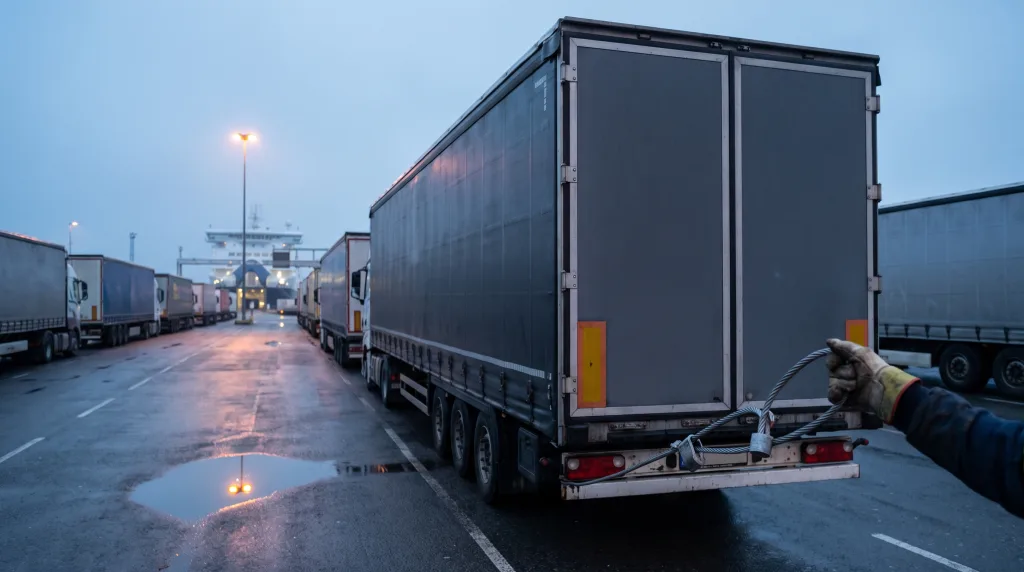
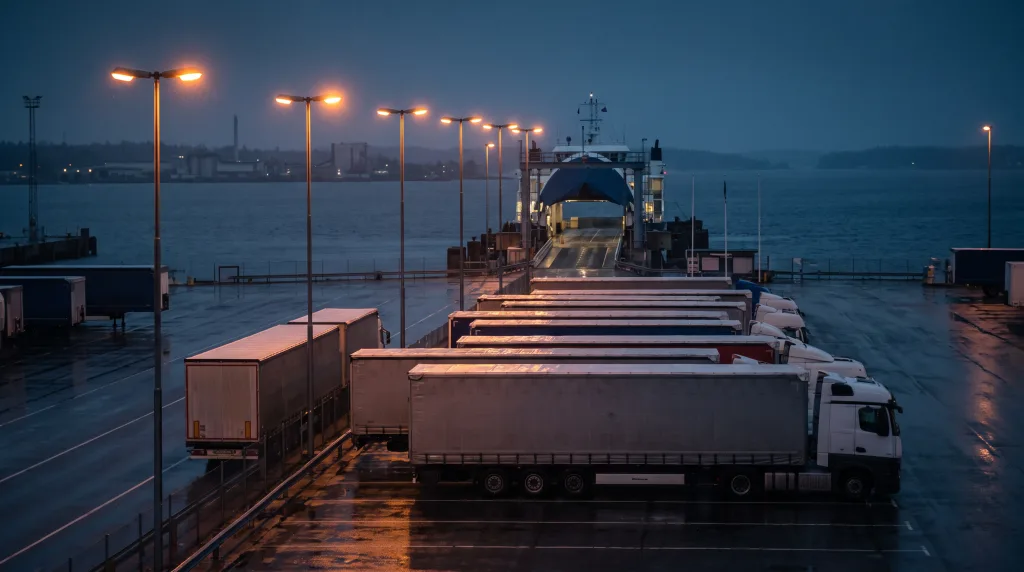
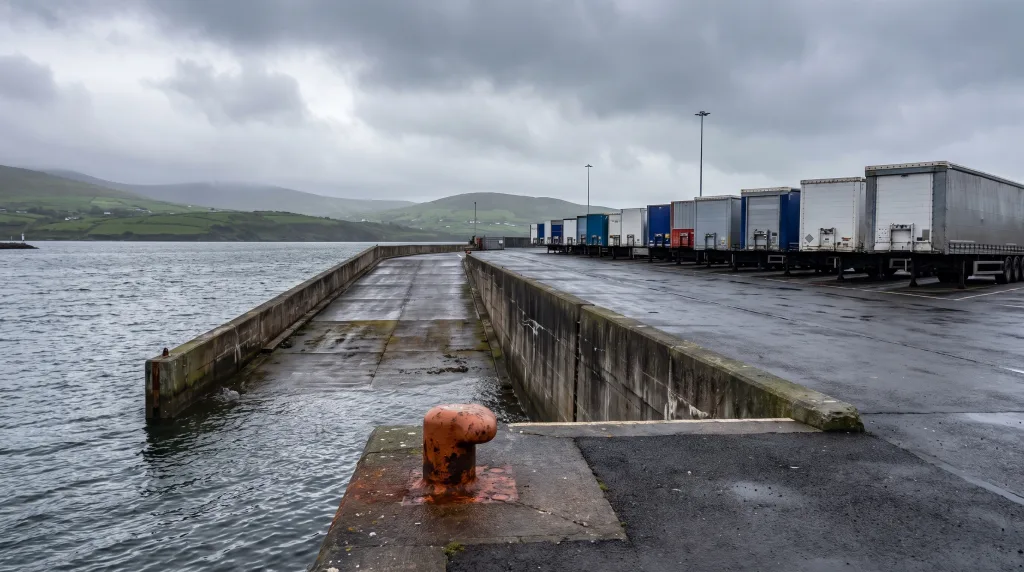
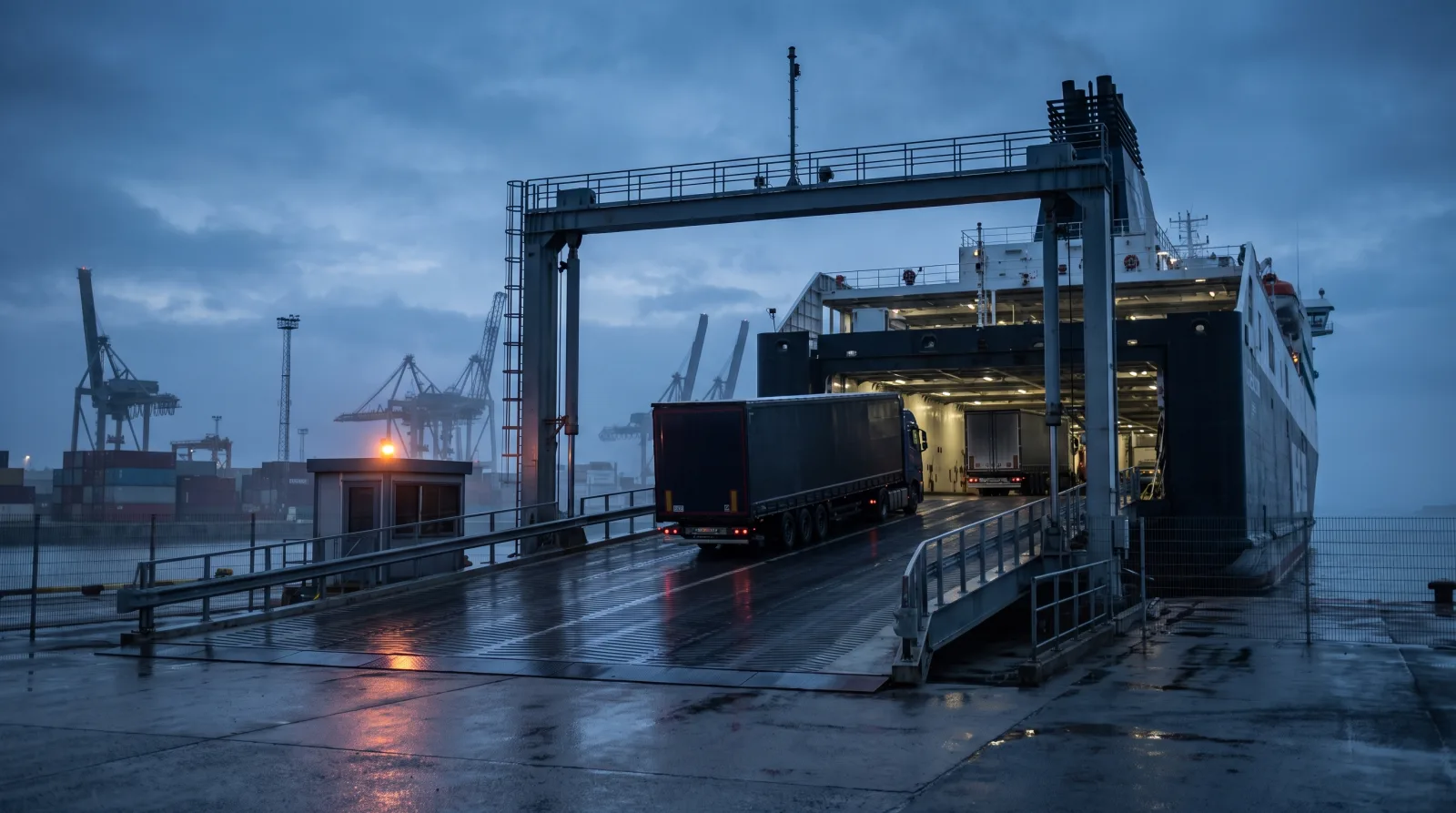
 AI image
From Kujawy and Pomerania in northern Poland there are two ways into Sweden: a ferry across the Baltic or the land route through Germany and Denmark over the Öresund bridge. The ferry options from Poland are Świnoujście–Ystad, Świnoujście–Trelleborg and Gdynia–Karlskrona. The choice depends on the loading and delivery points, the driver's hours and whether the truck returns loaded. Regular runs to Sweden for OTSL are made among others by a partner haulier based near Chełmno (86-200); we do not publish its name. Sweden is in the EU, so no customs clearance is needed.
Ferry or land: where does planning a run to Sweden start?
With the choice of crossing, because it sets everything else: loading time, the driver's hours plan and the delivery time. A Baltic ferry shortens the driving and gives the driver rest on board, but ties the run to the operator's timetable and requires a booking. The land route through Germany and Denmark over the Öresund bridge does not depend on a timetable, but means more kilometres and hours at the wheel plus crossing charges, whose amounts we do not quote because the crossing operators set them.
From Kujawy and Pomerania the ferry from Gdynia and the ferry from Świnoujście are both realistic alternatives: the partner's base near Chełmno sits on the A1 motorway, which leads north to Gdynia or west towards Świnoujście. Which port to pick depends on where in Sweden the consignee is: the south of the country is served differently from Stockholm and the north. Timetables, crossing times and prices are set by the ferry operators and are not given in this text; the forwarder checks them at booking.
Which Poland to Sweden ferry crossings are in play?
Three: Świnoujście–Ystad, Świnoujście–Trelleborg and Gdynia–Karlskrona. Ystad and Trelleborg lie in Skåne at the southern tip of Sweden, Karlskrona further east in Blekinge. Each of these ports can be reached from Kujawy and Pomerania within one driver shift, but the sum only adds up together with the onward leg on the Swedish side. That is why the forwarder calculates the route from loading dock to consignee's dock, not from port to port.
The partner haulier from the Chełmno area (86-200) performs regular runs to Sweden for OTSL. The type of those runs, their frequency and the partner's preferred crossing are not confirmed and not published; the owner of OTSL agrees them. If you want to run to Sweden in a similar model, write via the contact form with the subject "Carrier cooperation".
A run to Sweden step by step
- Addresses and time windows. The forwarder collects the loading point, the delivery point in Sweden and the hours in which the consignee receives goods. Southern Sweden and the Stockholm area are two different plans.
- Choice of crossing. Based on the addresses, the driver's hours and whether the truck returns loaded, the forwarder picks Ystad, Trelleborg, Karlskrona or the road through Denmark and the Öresund bridge.
- Ferry booking. The OTSL office books the sailing with the operator and passes the driver the booking number, check-in time at the port and terminal requirements. The driver does not phone for a slot from the road.
- Documents. Sweden is in the European Union, so there is no customs clearance. The cab must hold the CMR note and the commercial invoice; vehicle and driver details must match the booking.
- Loading and drive to the port. The driver checks the goods and load securing, enters reservations on the CMR where justified, and drives to the port with a margin for terminal check-in.
- Delivery and return. After unloading the consignee signs and dates the CMR. The return is planned together with the outbound run: an empty leg through Denmark looks different from a loaded ferry return.
Definitions
- Ferry crossing: the section of the route covered on a ro-ro ferry, in this article Świnoujście–Ystad, Świnoujście–Trelleborg or Gdynia–Karlskrona.
- Öresund bridge: the tolled road and rail link between Copenhagen in Denmark and Malmö in Sweden, part of the land route through Germany and Denmark.
- Ferry booking: reserving space for a vehicle on a specific sailing with the operator, done by the OTSL office before the truck leaves.
- CMR (Convention relative au contrat de transport international de marchandises par route): the convention on the international carriage of goods by road; the CMR consignment note is the core document of a run to Sweden.
- Ferry operator: the shipping company running a ferry line; it sets timetables, crossing times and prices.
- Kujawy and Pomerania: regions along the lower Vistula from which OTSL partners head north to Gdynia or west to Świnoujście along the A1 motorway.
Checklist before a run to Sweden
- Delivery point in Sweden known to the address and receiving hours, not just "Sweden".
- Crossing chosen and booked by the OTSL office; booking number and check-in time with the driver.
- Vehicle, trailer and driver details matching the booking; a last-minute change of truck means changing the reservation.
- CMR completed, commercial invoice in the cab; no customs documents, because Sweden is in the EU.
- Driver's hours plan covering the drive to the port, the sailing and the onward leg in Sweden.
- Return settled: a return load, an empty leg or a ferry from a different port.
When is the ferry the wrong choice?
The ferry is not always right. When the consignee is close to Malmö and the truck returns loaded through Germany anyway, the land route over the Öresund bridge can be simpler. When the operator's timetable does not fit the delivery window and moving to the next sailing means a day waiting in port, the decision depends on what costs more: a driver day or kilometres. The rule "from Kujawy and Pomerania look at the ferry first" does not apply either to loads that must first reach a warehouse buffer in Poland for consolidation; there the route is set from scratch. In short, the crossing is chosen for specific addresses and a specific driver, not out of habit. See also: Curtainsider on the Poland–England route: requirements before Dunkirk.
The OTSL role
OTSL plans a run to Sweden dock to dock: it picks the crossing, books with the operator and hands the partner driver the complete data, and it is answerable to the customer for the job. How our sailing reservations work is described on the service page ferry booking, and the destination itself on transport to Sweden. Ports and lines are covered in more depth in ferries to Scandinavia: routes from Polish ports, and the ferry-or-land question in transport to Scandinavia: ferry or land. Hauliers interested in regular runs to Sweden write via the contact form with the subject "Carrier cooperation".