 AI image
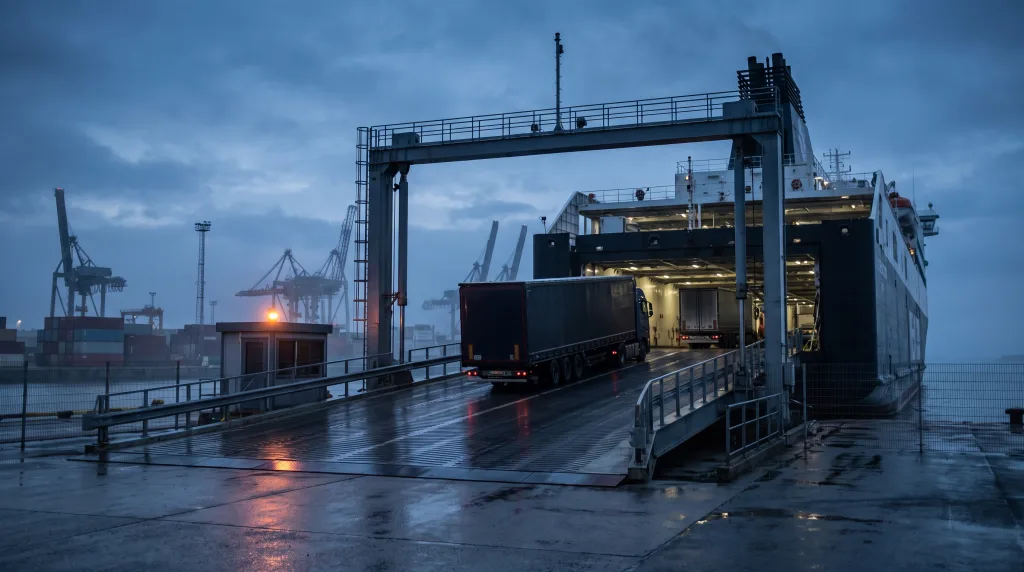
There are two ways into Sweden: a Baltic ferry, or an overland run through Denmark and the Öresund bridge. Planning every delivery starts with that choice. It is an EU market, so carriage runs with no customs clearance. OTSL runs FTL and LTL groupage with one forwarder in charge from collection to unloading, and sets the route and time buffers to the specific load so the delivery window stays reliable despite the sea crossing.
Baltic ferry or the Öresund bridge
The two realistic ways in differ in time, cost and exposure to conditions:
- Baltic ferry. A road leg from Poland to the port, the ferry crossing, then delivery on site. It cuts road kilometres but needs the ferry slot built into the schedule, plus a buffer for check-in and for weather on the Baltic.
- Öresund bridge (land bridge). An all-road route through Germany and Denmark, crossing the bridge between Copenhagen and Malmö. It gives more flexibility on timing but means a longer road distance and driving bans along the way.
For southern Sweden, around Malmö and Helsingborg, the Öresund bridge is often the natural choice. For Stockholm, Gothenburg and further north, the balance of kilometres and ferry slots decides. We set the route to the load, not the other way round, because the wrong crossing means either a lost day at the port or needless kilometres.
Crossings to Sweden as options: Ystad, Trelleborg, Karlskrona, Öresund
Three ferry crossings lead from the Polish coast to Sweden, and the fourth option is the road over the bridge. None of them is "the right one" by default: we match each to the delivery address, the driver's hours and whether there is a load for the way back.
| Crossing | Where it lands | When it makes sense |
|---|---|---|
| Świnoujście–Ystad | Skåne, south-west Sweden | Deliveries around Malmö, Helsingborg and on to Gothenburg; a short Polish road leg from the west of the country |
| Świnoujście–Trelleborg | Skåne, junction for Malmö and the E4/E6 | Loads for Stockholm and central Sweden, when the driver should roll off the ferry straight onto the motorway |
| Gdynia–Karlskrona | Blekinge, south-east Sweden | Collections from Pomerania, Kuyavia and eastern Poland; deliveries to Kalmar, Norrköping, Stockholm and the east coast |
| Öresund bridge (via DE and DK) | Malmö from the Copenhagen side | Loads from western and southern Poland, combined deliveries with Denmark, cargo not suited to ferries, or urgent runs outside a sailing slot |
The selection criteria never change. First, the delivery address and the consignee's opening hours, because they decide which port lets the driver reach the site within the unloading window. Second, the driver's hours, because a night sailing lets the driver take rest on board, while a long overland leg burns driving time before the border. Third, the return load, because a truck that has to collect goods in another part of Sweden should come back by a different crossing than it went out on. We do not publish timetables or fares here, because they change with the season and the operator; the forwarder confirms the actual sailing time at booking.
Road corridors from Poland
Loads to Sweden leave Poland in two main patterns: through the coastal ports where the Scandinavian ferry crossing starts, and overland through Germany and Denmark to the Öresund bridge. Transit time depends on the lane, the chosen crossing, the delivery windows at the receiver and driving bans on the way, so the forwarder confirms the real date at quotation. We do not put fixed hours up front, because on this direction the actual ferry timetable and the destination decide, not a rough estimate.
How long transport to Sweden takes
Transport to Sweden is made of three stages that are counted separately: the run from the loading point to the port or to the German border, the crossing (a sailing, or the drive through Denmark and over the bridge) and the leg from the port to the consignee. The total depends on the crossing and the address, so a single figure for the whole country would be misleading: a delivery to Malmö and a delivery to Umeå are entirely different jobs, even though both are "to Sweden".
What stretches the date in practice: a night sailing, which forces arrival at the port before the evening check-in; a run to the north of the country, where distances between towns are long and winter slows traffic; consignee unloading windows limited to a few morning hours; driving bans in Germany and Denmark if the route goes overland. What shortens it: loading in the morning of the sailing day; a delivery address close to the arrival port; a consignee that also accepts goods in the afternoon. The forwarder counts these stages at quotation and gives a date with a buffer, not a best-case date.
FTL or LTL groupage to Sweden
We move goods to Sweden as full FTL loads and as LTL groupage consolidated on the same direction:
- FTL, full load. One sender, one truck, a fixed export or import lane. It makes sense when you have a full set of pallets or a load that needs a dedicated rig.
- LTL groupage. From a single pallet upwards, sharing the cost of the crossing and the freight with other consignments to Sweden. It makes sense for smaller, regular shipments.
- ADR. Dangerous goods with full documentation and trained drivers.
- Reefer. Temperature-controlled cargo, with a temperature record on request.
- Oversized. Machinery and structures, with permits where required and equipment matched to the crossing.
The choice between FTL and groupage feeds straight into the rate and the timing: a full truck runs at its own pace, groupage waits for the direction to fill. Which one pays off, we advise at quotation based on pallet count, weight and urgency.
What we carry to Sweden
We serve the Swedish direction with the whole fleet we run across Europe, but every type of cargo has its own specifics on this lane:
- Full loads (FTL). Curtainsiders and mega trailers, including fixed lanes for furniture makers, automotive component suppliers and industrial equipment.
- Groupage from one pallet. Consolidated in Poland and dispatched on the Scandinavian direction; details on the groupage (LTL) service page.
- ADR. Dangerous goods board a ferry under different rules than they travel by road: operators restrict certain classes and quantities on deck, and the ADR cargo must be declared in the booking. Which classes cause trouble in groupage is covered in our article on ADR classes in groupage; carriage conditions are on the ADR transport page.
- Reefer. Food, pharmaceuticals and cosmetics under controlled temperature; on the ferry the unit runs throughout the sailing, which we agree with the operator at booking. More on the temperature-controlled transport page.
- Oversized. Machinery and structures beyond the standard profile need permits on the Swedish side, issued by Trafikverket; we check the scope and lead time for each load individually. The rules are explained in our article on abnormal load transport and on the out-of-gauge loads page.
- Exhibitions. Stand builds and exhibits for events in Stockholm, Gothenburg and Malmö, delivered within the build-up window and collected after dismantling.
Clearance, islands and what defines the direction
Sweden is part of the European Union and the customs union, so a standard commercial shipment from Poland runs with no clearance and no duty. The exceptions are excise goods or items under special requirements, which we check before loading. Deliveries to the islands, chiefly Gotland, need an extra ferry crossing from the mainland and its slots built into the schedule, so we plan those jobs with time to spare.
Sweden is a Nordic market with long distances between conurbations, where a predictable transit time matters more than the rate per kilometre alone. Traffic centres on the largest hubs: Stockholm, Gothenburg with its port, Malmö and Helsingborg in the south, and Jönköping in the central part of the country. Industry, furniture, automotive and retail generate a steady two-way flow on this direction, so a truck rarely runs back empty, and that keeps rates in check.
A job to Sweden step by step
- Quotation data. You give us the goods, the number and dimensions of pallets, the weight, the loading and delivery addresses, the consignee's hours and whether the deadline is fixed. On that basis the forwarder proposes FTL or groupage.
- Choosing the crossing. The forwarder sets the delivery address against the ports and the bridge, counts the driver's hours and checks whether a return load is available from the delivery area. The result is a specific route, not "ferry or bridge".
- Ferry booking. We reserve space for the rig on the chosen sailing, with vehicle, driver and cargo data (including ADR and temperature where relevant). Without a booking the driver cannot buy a ticket at the port gate.
- Loading. The driver checks the pallet count, packaging condition and load securing; we issue a CMR consignment note with the invoice as the accompanying document.
- Crossing. Check-in at the port before boarding closes, the sailing, roll-off. On the overland route: the drive through Germany and Denmark, allowing for driving bans and the bridge toll.
- Delivery. Arrival at the consignee within the unloading window, unloading by dock or tail lift if the vehicle has one and this was agreed.
- Proof of delivery (POD). The signed CMR comes back to you as a scan, and the original with the documents once the truck returns.
Checklist before shipping to Sweden
Most delays on this direction are caused not by the ferry but by one piece of information missing before departure. Before placing the order, check:
- the delivery address with postcode and goods-receiving hours; many Swedish warehouses stop receiving in the early afternoon;
- the number of pallets, their dimensions and the weight of the heaviest single pallet;
- whether the goods fall under ADR and, if so, the class, UN number and quantity, because this conditions the ferry booking;
- whether controlled temperature is needed and in what range;
- invoice details with the EU VAT numbers of the sender and the consignee, because an intra-EU supply needs them for reporting;
- whether the consignee has a dock or a forklift, or whether a tail-lift vehicle must be planned;
- a phone contact for the person receiving the goods, in case the arrival time changes.
Import from Sweden to Poland
Carriage from Sweden to Poland is an intra-EU supply, so it runs under the same rules as export: no customs clearance, on the basis of an invoice and a CMR consignment note. It also uses the same crossings, only in reverse: a ferry from Trelleborg, Ystad or Karlskrona, or the Öresund bridge through Denmark.
Import has one real organisational advantage. Trucks that have delivered to Sweden need a load for the way home, so a collection from a Swedish warehouse is often easier to plan than a one-off dispatch. The forwarder ties the collection to the return leg, which lowers the freight cost for both sides. Typical cargo in this direction is steel products, paper and pulp, industrial components, plus returns and packaging.
What OTSL organises
- Choosing the crossing: Baltic ferry or the Öresund bridge, matched to the load and the destination.
- Ferry booking and fitting the crossing slots into the schedule, with a buffer for check-in and weather.
- FTL and LTL groupage, consolidated on the Scandinavian direction.
- ADR, reefer and oversized, with equipment and routes matched to each.
- One forwarder running the whole job and one point of contact for the entire transport.
For a quote we need a description of the goods, dimensions, weight, the loading and delivery points and whether a deadline matters. On that basis we propose a transport option and a crossing, and we keep contact through the form.
Why OTSL on the Swedish direction
We serve the Swedish direction in a standing partnership with a partner haulier based near Chełmno (86-200) in northern Poland, who runs regular services to Sweden and knows the ports of Świnoujście and Gdynia from practice, not from a map. The scope and rhythm of those runs are agreed with each customer for the specific lane. We do not buy loads on freight exchanges and we do not look for "a truck for today": the driver carrying your goods has passed our vetting and works with us on a regular basis.
One forwarder runs the job from quotation to proof of delivery. The same person picks the crossing, books the ferry and answers the driver's call when the sailing is late. The operations team is available around the clock, so a night sailing or an early unloading in Sweden is never left unattended. We also offer ferry booking as a separate service for companies that run their own trucks but do not want to manage reservations themselves: see the ferry booking page.
What to watch out for on transport to Sweden
- No ferry booking. A driver cannot buy a ticket for a rig at the port gate the way a tourist does. Space must be reserved in advance with vehicle and cargo data; without it the truck waits for the next sailing with free deck space.
- Driver's hours versus sailing time. The run to the port must fit within the daily driving limit with a margin for check-in. A night sailing can work in your favour, because the driver takes rest on board, but only if loading finished on time. How those hours are counted is explained in our article on driver hours and the tachograph.
- Öresund bridge and tunnel tolls. Crossing the Öresund is charged for trucks; the toll level is set by the crossing operator and changes independently of us, so we quote it as a separate line rather than folding it into a per-kilometre rate.
- Driving bans in Germany and Denmark. The overland route is subject to Sunday and public-holiday bans along the way; leaving on a Friday afternoon without a plan for the weekend ends in a lay-by. Details in our article on HGV driving bans in Europe.
- Winter in the north. From autumn to spring, routes north of Stockholm mean slower driving, mandatory winter tyres for trucks and a risk of road closures. We plan deliveries to the north with a larger buffer than to Skåne.
- Consignee receiving hours. Many Swedish warehouses take goods only in the morning and early afternoon; a truck that rolls off the ferry in the afternoon may not unload until the next day.
Sweden as part of a Scandinavian plan
A route to Sweden rarely ends in Sweden. On the overland route the truck drives through Denmark anyway, so a delivery to Copenhagen, Aarhus or Odense can be combined with unloading in Malmö or Gothenburg in one plan. From Gothenburg it is a short run to the Norwegian border: the Svinesund crossing leads to Oslo, but Norway lies outside the customs union, so that part of the route needs an EU export declaration, a pre-notification in the Norwegian Digitoll system and import clearance on the Norwegian side.
When planning deliveries to several Nordic countries at once, we sequence the unloadings so that the EU part (Denmark, Sweden) runs without formalities and the crossing into Norway is the final stage with a full set of customs documents. See the destination pages transport to Denmark and transport to Norway, and the border procedure in our article customs clearance for transport to Norway step by step.
See also
- Transport to Scandinavia: Sweden, Denmark, Finland
- Ferries to Scandinavia: routes from Polish ports
- Ferry booking as a service
- Transport to Denmark
- Transport to Norway
- FTL or LTL: when to use a full load or groupage
- What an FTL rate is made of
- HGV driving bans in Europe
- Transport to the Baltic states
- Groupage and part loads across Europe
- Express vans when every hour counts