 AI image
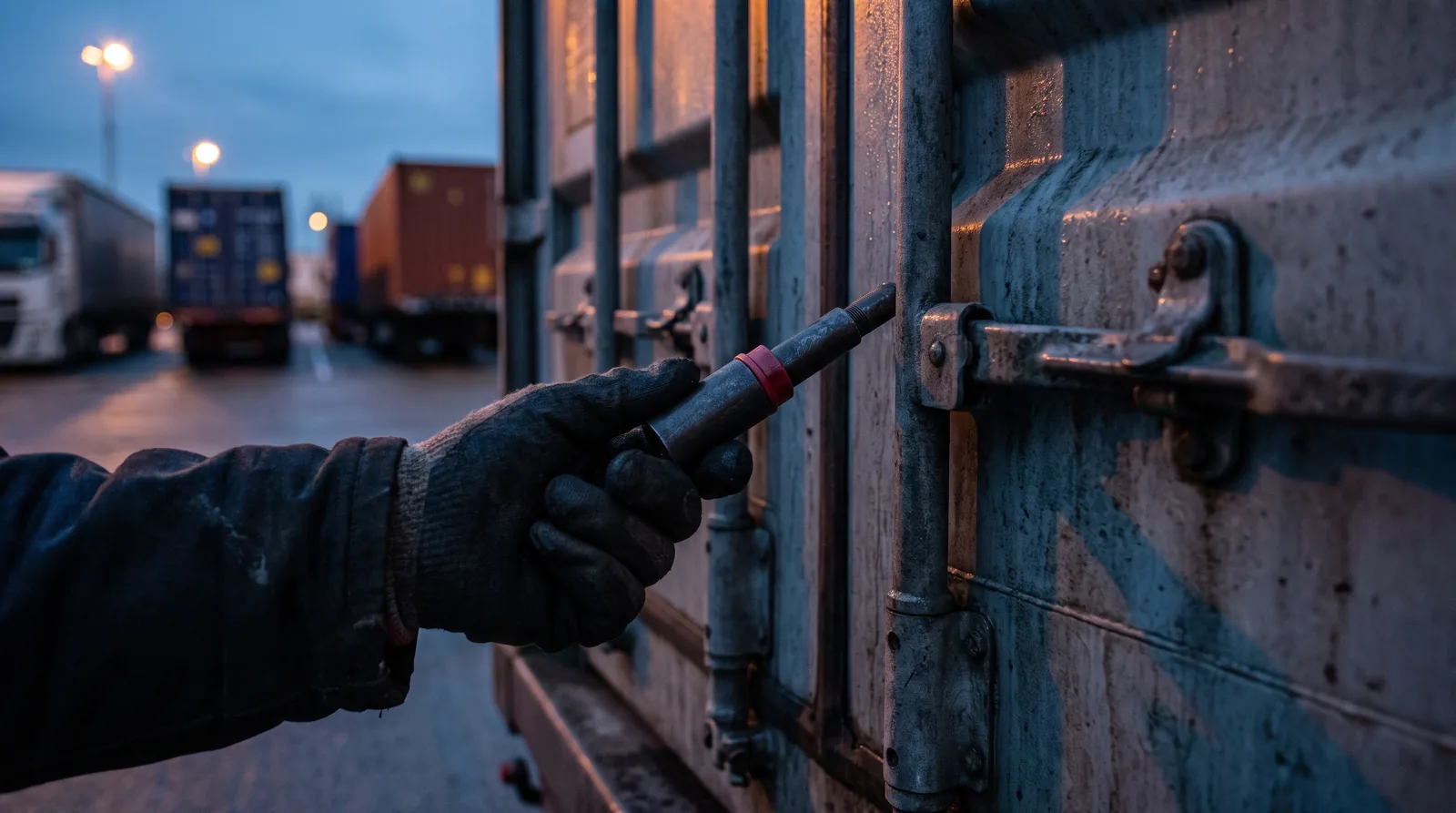
A trailer seal will not stop a determined thief, but it settles disputes. A seal number entered in the CMR note (Article 6(3) of the Convention) and photos taken at loading prove the cargo space travelled closed, and a check after every stop narrows down the moment of any access to the goods. Require ISO 17712 compliant seals, a full sealing protocol and a fixed procedure for a breach.
Why does seal a trailer that already has lock?
A seal costs pennies and works on three fronts at once. The first is theft. Offenders increasingly leave the trailer where it stands: they slash the curtain or open the doors at a truck stop and disappear with part of the load, and the shortage surfaces only at unloading, hundreds of kilometres later. A numbered seal and a check log narrow the incident down to a single stop, which matters directly to the police and the insurer. We cover the scale of the problem in cargo theft from truck parks.
The second front is the UK border. Every person found in the load space exposes the responsible parties to a civil penalty of up to 10,000 GBP, and the UK vehicle security guidance expressly requires sealing and documented checks (gov.uk). An intact seal and a completed checklist are the main line of defence for the carrier and its principal; what happens after people are found is described in trailer inspection after clandestine entrants. The third front is the dispute with the consignee: the carrier is liable for the goods from takeover to delivery (Article 17(1) CMR), and a seal whose number matches the consignment note is one of the few pieces of evidence that nobody reached the load in transit. For food and pharmaceuticals a broken seal additionally raises a product safety question, not just a shortage claim.
Seal types and ISO 17712 classes
ISO 17712:2013 grades mechanical seals by their resistance to removal and tampering, and the class must be permanently marked on the seal body. The reference point is the American supply chain security programme CTPAT, which requires ISO 17712 compliant high-security seals on cargo entering the United States (cbp.gov). European road transport imposes no statutory class, which is exactly why the requirement has to be written into the transport order.
| Seal type | Typical ISO 17712 class | Typical use | Notes |
|---|---|---|---|
| plastic pull-tight strap | I (indicative) | low-risk deliveries, groupage, curtainsiders | reveals opening, offers no resistance; can be torn off by hand |
| cable seal | S or H | curtainsiders with a TIR cord, drop sides, tankers | adjustable length; removal requires cable cutters |
| bolt seal | H (barrier) | containers and box trailers, high-risk lanes | the standard in maritime export; removal requires bolt cutters |
| customs seal | affixed by the authorities | transit, the TIR procedure, inspections | removed only with the authorities' consent; a breach requires an official report |
| electronic seal (e-seal) | complement to a mechanical seal | high-value cargo, fleet monitoring | opening alert with location and time; does not replace the mechanical evidence |
The seal number in the CMR note and photo evidence
The CMR Convention does not list the seal among the mandatory particulars of the consignment note, but Article 6(3) allows the parties to enter any other particulars they deem useful. A seal number entered in the note and covered by the parties' signatures then works through Article 9: the consignment note is prima facie evidence of the contract and of the taking over of the goods. A seal whose number appears nowhere in the paperwork is, in a dispute, almost the same as no seal at all.
The practice looks like this: the loader fits the seal once loading is complete, with the driver present, and the driver compares the number with the CMR entry before pulling away. Add three photos: the legible seal number up close, the closed doors with the seal fitted, and the whole trailer at the ramp, all sent to the forwarder immediately, with the date and time preserved. If the driver could not attend the loading or check the contents, he enters a reasoned reservation under Article 8(2) CMR, for example "loaded and sealed by the sender, contents not checked". How to complete the remaining boxes is covered in how to fill in a CMR consignment note.
Checks at breaks and the procedure after a breach
A seal only works together with a check log. The UK vehicle security checklist (gov.uk) requires the driver to examine seals, locks, the curtain and the load space after every stop and to record the result with the place and time. The same rhythm protects against theft: a driver who confirms the seal number after every break can point to the exact truck stop where the interference happened, instead of answering for the whole route. Parking discipline helps too: trailer doors pushed up against a wall or another vehicle cannot be opened without moving the rig.
When the seal is broken, damaged or the number does not match the note, the order of steps is fixed:
- Do not open, do not drive on without instructions. Every further opening blurs the picture and weakens the evidence.
- Document the scene as found. Photos of the seal, the doors, the ground and the surroundings before anything is touched.
- Notify the forwarder and the principal. Where theft or people in the trailer are suspected: also the police of the country of the stop.
- Customs seal: call the authorities. The TIR Convention (Article 25) requires a breach of customs seals to be certified by the competent authorities in an official report; driving on unilaterally closes that route.
- New seal, new entry. The journey continues only with a new seal of a recorded number, noted in the documents and in the correspondence.
- Reservations at unloading. Apparent loss or damage must be reserved in the note at delivery at the latest, non-apparent within 7 days (Article 30 CMR); the mechanics are described in CMR reservations on delivery.
Sensitive goods should not enter circulation after a seal breach without an examination. What a witnessed opening, assessment and report look like is shown in the cargo inspection process.
Sealing requirements for the carrier's transport order
- Seal class. For valuable goods and food, say it outright: a cable or bolt seal compliant with ISO 17712, with spare seals in the cab for any legitimate opening.
- Who seals and in whose presence. The loader fits the seal once loading is complete, with the driver present; the driver confirms the number by signature or photo.
- Number in the CMR plus photos before departure. The seal number in the consignment note (Article 6(3) CMR) and the full photo set sent to the forwarder before the rig leaves the ramp.
- A check after every stop. Confirmation of the seal number and condition after every break, recorded with place and time, in line with the UK checklist.
- No removal without instructions. Neither the driver nor the consignee removes the seal before the number is written down and photographed; roadside and customs checks are recorded with the officers' details.
- A breach procedure with a response time. The order should name who the driver notifies and how fast, and state that every legitimate opening ends with a new seal and a new entry.
The OTSL role
As an international freight forwarder we write sealing requirements into transport orders, collect the loading documentation and run the process when a seal turns out to be breached en route: from securing the evidence to a witnessed opening and report at our warehouses in Kielce, Legnica and Milton Keynes. We run traffic between Poland, the United Kingdom, Switzerland and the rest of Europe. See inspection and recovery and the transport risks section, and discuss a specific movement through the contact form.
Step by step
- Technical check. Inspect the trailer doors, hinges, and locking bars before loading begins.
- Seal application. Close the cargo area and fit the appropriate security seal to the primary locking mechanism.
- Document entry. Record the unique seal number accurately in the CMR note and complete the sealing protocol.
- Photographic record. Take clear photographs of the fitted seal showing the unique number before departure.
- En-route inspection. Verify the condition and seal number after every rest stop and border point.
Definitions
- CMR consignment note (Convention relative au contrat de transport international de marchandises par route): The standard international transport document where the applied seal number is recorded.
- Indicative seal (Class I): A single-use closure designed to clearly show any attempt to open the cargo space without providing physical resistance.
- Security seal (Class S): A mechanical seal offering medium strength to restrict unauthorised access to the container or trailer.
- High-security seal (Class H): A heavy-duty barrier seal complying with ISO standards that requires dedicated bolt cutters for removal.
- ISO (International Organization for Standardization) 17712: The international standard defining technical criteria and strength classifications for freight container and trailer seals.
When does this rule not apply?
The requirement to apply a seal does not apply to open flatbed transport, oversized cargo, or vehicle transporters. This rule also does not apply when border control or customs authorities demand the removal of the seal for physical cargo inspection.