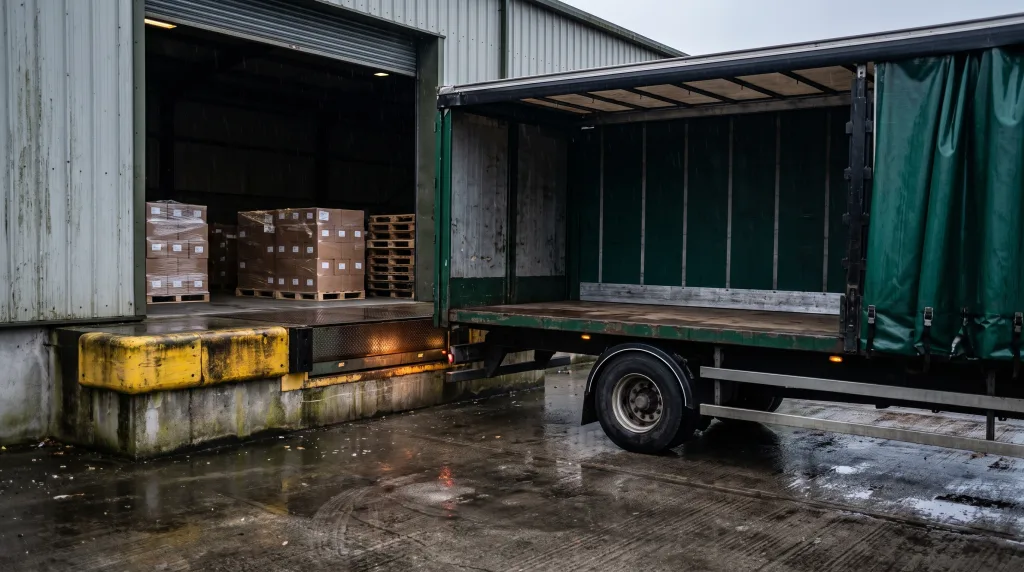
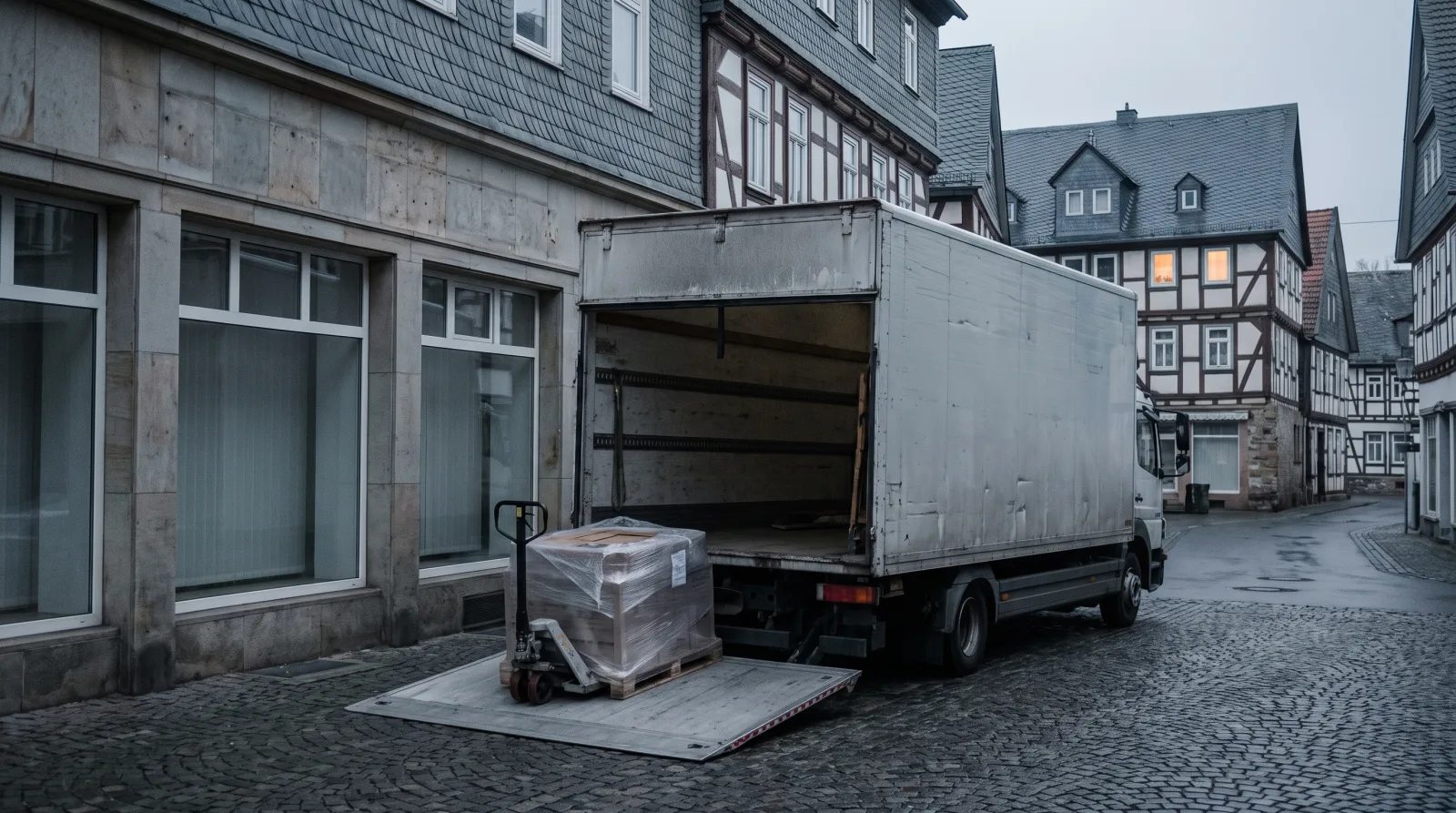
 AI image
At OTSL an 18-pallet rigid truck with tail lift is the vehicle for deliveries where the consignee has no loading bay and no forklift: shops, workshops, offices, construction sites and exhibition halls. It runs on regular lanes to Germany, the Netherlands, Belgium, France and Austria, plus exhibition logistics across Europe. One of our partner carriers, a haulier based near Kwidzyn in northern Poland (postcode 82-500), covers the whole of Europe with such trucks. The driver receives ready data from the forwarder: verified unloading conditions, delivery notification and exhibition booking-in.
Which jobs go to a tail-lift rigid?
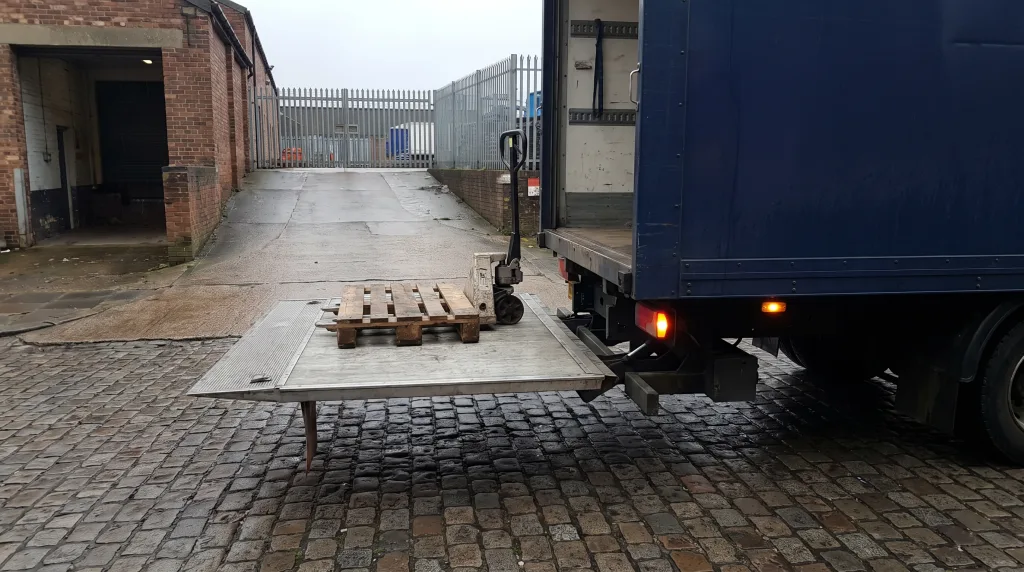
An 18-pallet rigid (18 EP in Polish fleet shorthand) is a single-body truck without a trailer, taking 18 euro pallets at a gross vehicle weight of 18 tonnes. It carries a tail lift rated up to 1.5 tonnes per cycle and a hand pallet truck on board. The 12-tonne variant works the same way with less payload. This truck gets the jobs an articulated unit cannot do: a shop in a town centre, a workshop behind a housing estate, an office without a dock, a construction site or an exhibition hall during its build-up window.
The common denominator is the missing loading bay at the receiving end. The partner driver lowers each pallet on the tail lift and moves it with the pallet truck to the spot named in the order. That is why pallet weight, condition and ground surface matter as much as pallet count. The OTSL forwarder collects this information before departure, not the driver at the gate.
Which routes does the partner truck run?
OTSL's regular lanes for tail-lift rigids are Germany, the Netherlands, Belgium, France and Austria. On top of that comes exhibition logistics across Europe: stand structures and exhibits delivered to the hall, with delivery slots and booking-in arranged by the forwarder. The partner carrier from the Kwidzyn area (82-500) runs 18-pallet tail-lift rigids across the whole of Europe. We do not publish the company's name, and contact goes exclusively through OTSL, because OTSL is the party answerable to the customer for the job.
The frequency of runs and the partner's settlement terms are not published; the owner of OTSL agrees them with each haulier individually. If you operate a rigid with tail lift and want to work in a similar model, use the contact form with the subject "Carrier cooperation".
A tail-lift rigid job step by step
- Quote with an unloading question. The forwarder asks the customer about the loading bay, ground surface, access, opening hours and access restrictions. At this stage it becomes clear whether a tail lift is enough at all.
- Pallet weight check. A single pallet heavier than 1.5 tonnes, non-palletised goods or an unloading point deep inside a yard rule out the tail lift. OTSL then proposes a crane truck (HIAB) or unloading by the consignee, and says so in the quote.
- Order to the partner. The haulier receives the full data set: addresses, time windows, pallet count and weights, the agreed unloading method and the consignee's contact.
- Notification and booking-in. At exhibitions the forwarder handles delivery notification and booking-in. The driver gets a slot number, a pass and access directions rather than an instruction to "find out on site".
- Loading and transit. The driver checks pallet condition and load securing, enters reservations on the CMR consignment note where justified, and leaves according to the driving-time plan.
- Unloading and proof. The pallet comes down on the tail lift, the consignee signs and dates the CMR. A scan or photo goes to OTSL as proof of delivery.
Definitions
- 18-pallet rigid: a single-body truck without trailer taking 18 euro pallets, gross vehicle weight 18 tonnes.
- EP (euro pallet): the standardised 1200 × 800 mm pallet used as the unit for counting body space.
- Tail lift: a hydraulic platform at the rear of the truck that lowers a pallet from body floor to road level; on OTSL rigids rated up to 1.5 tonnes per cycle.
- Hand pallet truck: the manual truck the driver uses to move a pallet from the lift to the drop point over hard, level ground.
- HIAB (lorry-mounted crane): a crane fitted to the vehicle, the alternative to a tail lift for heavy or non-palletised loads.
- Booking-in: reserving an unloading window with the consignee or exhibition organiser, done by the forwarder before the truck leaves.
Checklist before a tail-lift rigid run
- Weight of every pallet known and below 1.5 tonnes; heavier pallets reported to the forwarder before loading.
- Unloading conditions confirmed with the consignee: surface, gradient, access, hours, entry restrictions.
- Notification or exhibition slot number in the order, together with an on-site contact.
- Working tail lift and pallet truck on board, straps and anti-slip mats suited to the load.
- Driver's hours plan consistent with the delivery window and the return to base.
- Full set of CMR notes and commercial invoice in the cab; for exhibitions, the documents required by the exhibitor manual.
When is a tail-lift rigid the wrong truck?
The tail lift does not apply to every delivery without a loading bay. When a single pallet weighs more than 1.5 tonnes, when goods are not palletised, or when the drop point lies deep inside a yard with no hard access path, unloading by tail lift and pallet truck is not an option. OTSL then proposes a crane truck, unloading by the consignee or delivery to a warehouse buffer. The choice of vehicle depends on the conditions at the consignee, not on which truck happens to be free. The working rules above cover jobs placed by OTSL; on runs the partner performs for other principals, the terms of those contracts apply.
The OTSL role
OTSL runs the job from quote to proof of delivery and is answerable to the customer for it. Before the partner driver leaves, the forwarder verifies unloading conditions and entry restrictions, arranges notification and exhibition booking-in, and prepares the full document set. The service is described on the page rigid truck with tail lift, 12 t and 18 t. How many pallets fit and what the lift can take is explained in pallets on a 12 t and 18 t rigid and tail-lift capacity, and the choice between lift, dock and crane in tail lift, crane or dock. Hauliers with rigid trucks interested in working with us write via the contact form with the subject "Carrier cooperation". See also: Kwidzyn and Powiśle: where our partner hauliers with rigid trucks run and Tail-lift unloading: pallet weight, ground and the right to refuse.