 AI image
Steel and metal products transport moves heavy, often long freight prone to shifting: coils, sheets, sections, bars and tubes. The service is for steel mills, service centres, structural fabricators and construction firms that need trailers matched to the shape and securing that resists rolling and sliding. OTSL arranges carriage with the right equipment and lashing chosen for the specific product.
What it covers
- Carriage of coils, sheets, bars, sections and tubes across Poland, the United Kingdom, Switzerland and the rest of Europe.
- Trailer selection for the product, including coil-well (coilmulde) trailers for eye-vertical and eye-to-side coils.
- Load planning against permitted axle weights, so no single axle is overloaded.
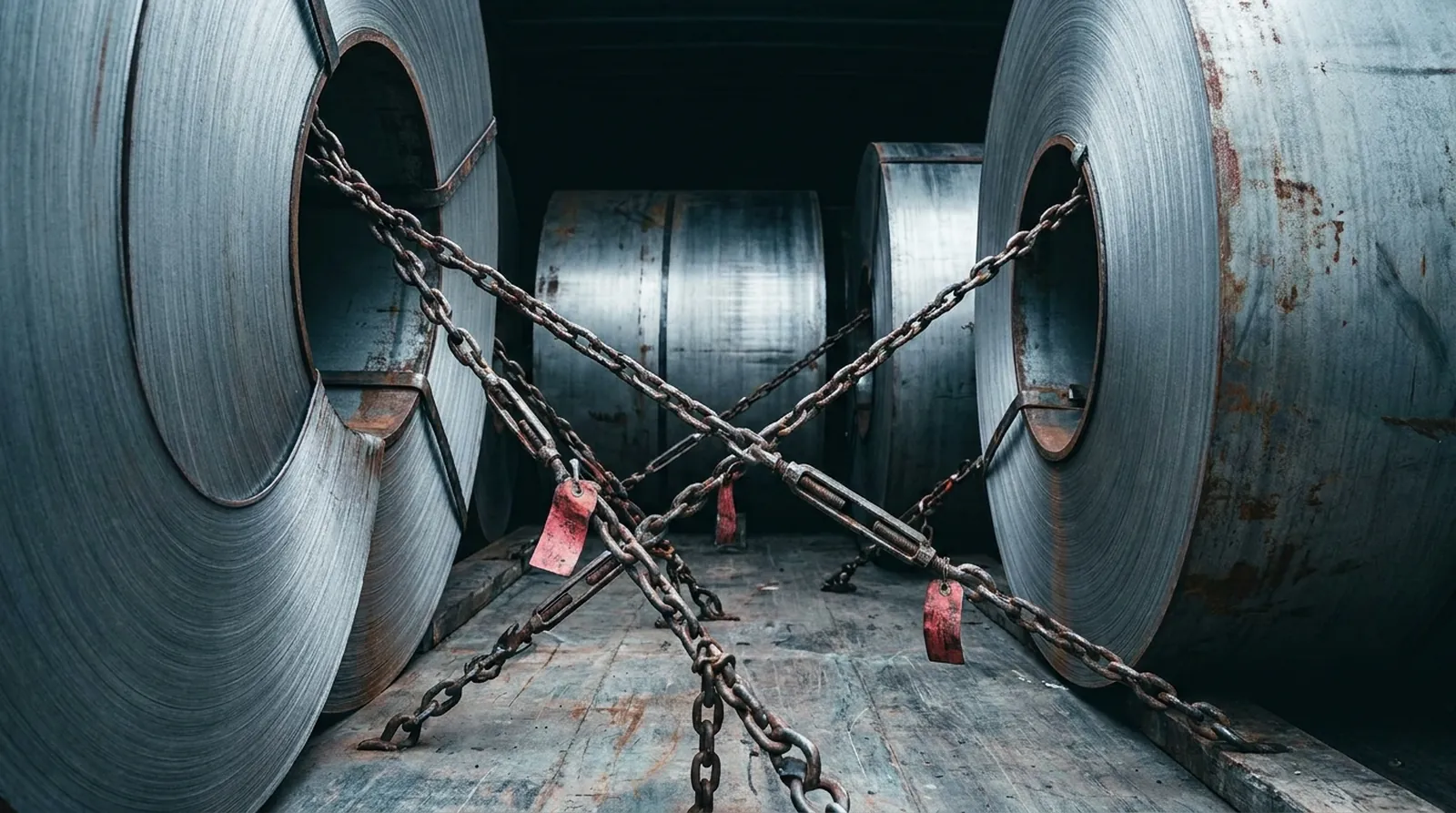
- Securing: straps, chains, wedges, blocking bars, anti-slip mats and edge protectors.
- Abnormal-load organisation with permits and an escort where dimensions or weight exceed the limits.
- Transport documentation (CMR note) and customs support for steel imported from outside the EU.
- Buffer warehouses in Kielce, Legnica and Milton Keynes for cross-docking and consolidation.
How we do it
We start from the cargo data: unit mass, dimensions, shape and centre of gravity. From that we choose the trailer and plan placement so the weight spreads across the axles within permitted limits rather than concentrating at one point. Coils go into the coil-well and are chocked against rolling, sheet packs are strapped over edge protectors, and long sections and bars are secured with chains or ratchet straps.
We size the securing to hold the forces that arise under braking and in bends; the method for calculating those forces and choosing the securing means is set out in standard EN 12195-1. Anti-slip mats raise friction and limit movement. We check the securing before departure and inspect it in transit, because heavy freight reacts to every hard brake.
Limits of the service (what it does not cover / what to know)
We do not handle crane loading or product processing at the mill; preparing the load and declaring the true mass sits with the shipper. Wrong data is not a detail: badly distributed weight ends in an axle-weight breach, a fine at a roadside check and a turned-back vehicle, while weak securing can let coils shift in transit. For steel imported from outside the EU, from 2026 the CBAM mechanism enters its definitive phase: the importer needs authorised declarant status and buys and surrenders CBAM certificates, while plain reporting applied in the 2023 transitional phase; that is a customs and tax matter to close before delivery.
See also
- Securing cargo in practice: straps, mats, blocking bars, corner protectors
- Overloading and axle weight: who pays the fine
- Abnormal load transport: permits and escort, UK and Poland
- Load securing: who is liable, carrier or shipper
- CBAM: steel and aluminium imports into the EU from 2026
- Contact: enquire about a steel shipment